Try our 1-minute short audio summary of this blog on IVR vs AI Voice Agents. 🎧
Think about the last time you called a company for help. You probably heard something like: “Press 1 for sales. Press 2 for support. Press 3 for billing.” You pressed 2. Then: “Press 1 for technical issues. Press 2 for account queries.” By option 4, you’d already mentally moved on.
That frustration is exactly why businesses are rethinking their phone communication strategy in 2026. The AI voice agent market is growing rapidly, with industry reports projecting strong double-digit CAGR growth over the next decade. It’s because traditional IVR systems, while reliable, were built to manage call traffic. Not conversations.
But that doesn’t mean IVR is dead. The real question isn’t AI voice agents vs IVR; it’s which architecture actually fits your business. This guide breaks it down clearly so you can make that call with confidence.
- What Is Traditional IVR?
- What Are AI Voice Agents?
- Why Businesses Are Moving Beyond Traditional IVR
- Where Traditional IVR Still Makes Sense
- Why Most Businesses Need a Hybrid Model
- How to Decide: AI Voice Agent, IVR, or Both?
- The Future of Customer Communication
- Challenges Businesses Should Consider Before Deploying AI Voice Agents
- Conclusion
What Is Traditional IVR?
Interactive Voice Response is an automated phone system that interacts with callers through pre-recorded menus. Callers navigate using touch-tone inputs (DTMF), pressing numbers on their keypad, and the system routes them to the right department or delivers recorded information.
The flow is straightforward:
- Caller dials in
- Pre-recorded menu plays
- Caller presses a key
- The system routes the call or delivers information
- Escalates to a human agent when the menu options run out
For businesses seeking cloud telephony solutions, IVR excels at OTP delivery, account balance checks, and appointment reminders.
Strengths of IVR
- Low setup cost and fast deployment
- Highly reliable, it runs the same script every time
- Easy to maintain once the menu is configured
- Proven at scale across industries
IVR was designed to manage call volume, not to hold a conversation. For simple, repetitive, and predictable interactions, it still does the job well.

Related Reading
What Are AI Voice Agents?
An AI voice agent is software that handles phone calls end-to-end using artificial intelligence. Unlike IVR, it doesn’t ask callers to choose from a menu. Instead, it listens, understands intent, and responds, conversationally, in real time.
How AI Voice Agents Work
AI voice agents combine speech recognition, intent detection, contextual understanding, and CRM integration to understand customer requests and respond conversationally in real time.
Additionally, the AI supports multiple languages, generating responses rather than relying on pre-recorded clips. It can also handle lead qualification and appointment scheduling entirely without agent involvement while providing fully automated resolutions for order tracking and return requests.
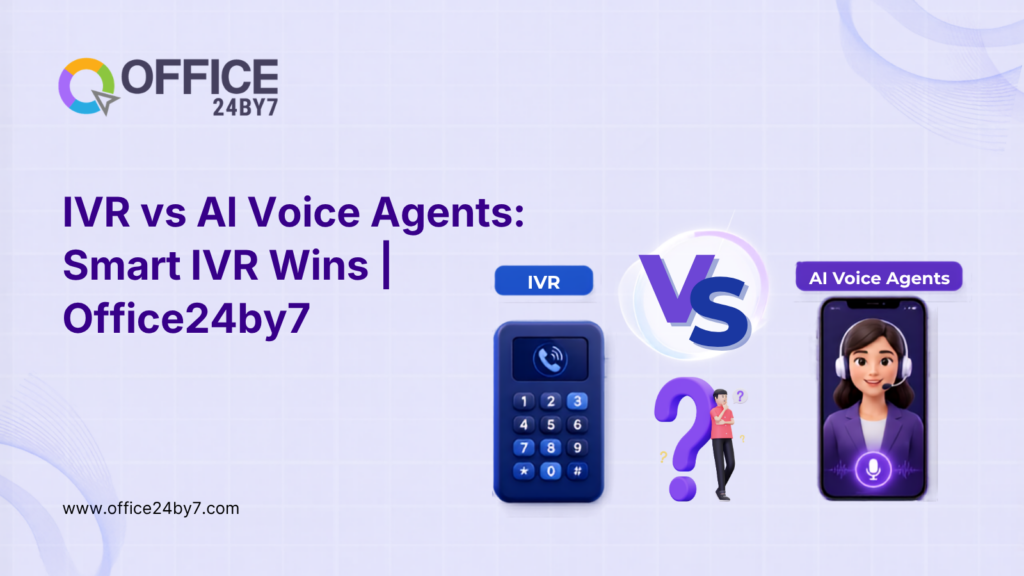
AI Voice Agents vs IVR: Key Differences at a Glance
| Feature | Traditional IVR | AI Voice Agent |
| Interaction style | Menu-based, keypress | Natural conversation |
| Customer effort | High | Low |
| Context awareness | No | Yes |
| Personalization | Limited | Dynamic |
| CRM integration | Basic | Real-time |
| Multilingual support | Pre-recorded only | AI-driven |
| Self-service capability | Limited self-service resolution | Higher self-service resolution capability |
| Deployment complexity | Low | Medium |
| Best use case | Routing | Resolution |
Traditional IVR systems generally resolve a smaller percentage of customer queries without agent intervention, while AI voice agents can automate a much larger share of routine interactions.
Why Businesses Are Moving Beyond Traditional IVR
Here is what happens when IVR gets in a customer’s way. They repeated their account number to three different agents because the system didn’t retain it. They navigate four menu levels to reach billing, only to be told they need to call a different number. They wait six minutes on hold after “pressing 3 for support”, and then hang up.
Frustrating IVR experiences can significantly impact customer satisfaction and retention, especially when callers struggle with long menu paths, repeated inputs, or delayed support.
Research shows that complex IVR flows and long wait times contribute significantly to call abandonment in contact centres.
Instead of navigating menus, callers can describe their issue naturally, for example, instead of IVR saying: “Press 3 for billing enquiries.” The customer simply says: “I want to pay my outstanding bill.”
The AI understands the request, retrieves the relevant account information, and completes the interaction without requiring multiple transfers or menu selections.
The Business Impact
When businesses switch from rigid IVR to conversational AI for customer support, they typically see measurable improvements in:
Many businesses use AI voice automation to reduce repetitive support workload and improve agent efficiency.
- First-call resolution rates, more issues closed on the first interaction
- Average handling time, shorter calls because context is retained
- Agent productivity, human teams focus on complex, high-value conversations
- Customer satisfaction scores, callers feel heard, not routed
Where Traditional IVR Still Makes Sense
IVR remains highly effective for structured workflows and predictable customer interactions.
Low Call Volumes with Simple Interactions
If your business handles fewer than 5,000 calls a month and most queries are predictable- balance checks, delivery confirmations, OTP delivery- IVR delivers what you need at a fraction of the cost of AI deployment.
Structured, Compliance-Driven Workflows
In regulated industries, some workflows require rigid, auditable scripts. IVR’s rule-based nature makes it easier to demonstrate compliance with fixed call flow documentation.
Budget-Conscious Deployments
Startups and SMEs that need to be operational quickly benefit from IVR’s low setup cost and fast go-live. Voice AI for business makes more financial sense once call volumes and the cost of agent time justify the investment.
IVR isn’t dead. It’s still highly effective for repetitive, predictable workflows where the answer is always the same and the query is always simple.
Where AI Voice Agents Deliver Greater Value
IVR helps a great deal in various sectors. Some of them are:
- Healthcare
AI voice bots handle appointment scheduling, prescription reminders, and lab result notifications, reducing front-desk load significantly. Patients can receive support at any hour, often in multiple regional languages. - BFSI
Banks and financial institutions use AI call automation to manage card blocking, collections follow-ups, loan enquiry routing, and account queries, reducing the need for escalation to human agents in many routine cases. - E-commerce and Logistics
Order tracking, delivery updates, and return requests are high-volume, low-complexity tasks perfectly suited to conversational AI for customer support. Businesses also combine AI voice systems with SMS marketing services to send instant updates, reminders, and follow-up notifications automatically. - Real Estate
AI voice agents qualify inbound leads, confirm site visit schedules, and follow up on enquiries, all without a sales executive picking up the phone. The CRM updates automatically after every call. - Education
Admission enquiries, fee reminders, and exam schedule notifications reach students and parents instantly, at scale, in regional languages, without requiring a dedicated call team.
Why Most Businesses Need a Hybrid Model
Most businesses benefit more from a hybrid communication model than a fully AI-only setup. What actually works in 2026 is a calibrated hybrid, and here is exactly how it functions:
Customer calls in → AI voice agent understands intent → CRM retrieves customer history → Smart IVR routes complex cases appropriately → Human agent joins only when genuinely needed.
A hybrid approach combining smart IVR, CRM software, and human escalation ensures businesses scale communication without losing personalization. Agents equipped with click-to-call software can jump into live calls instantly, with full CRM context already on screen, no manual dialling, no blind transfers.
This architecture delivers the best of both technologies:
- Routine interactions are automated, while complex cases move to human agents.
- IVR manages structured escalation paths, directing complex cases to the right team
- Human agents focus entirely on conversations that require empathy, judgment, or authority
A connected missed call alert system also ensures businesses never lose high-intent inbound enquiries.
Related Reading
How to Decide: AI Voice Agent, IVR, or Both?
The right choice depends on where your business actually stands, not where you’d like it to be.
Traditional IVR makes sense when your call flows are simple and highly predictable, queries are repetitive with fixed answers, budget is the primary constraint right now, and fast deployment matters more than personalisation. If all three boxes are ticked, IVR gets the job done without overcomplicating it.
AI voice agents are beneficial when customer experience is a key measurable KPI. They are essential for handling diverse, context-dependent queries, providing 24/7 support without increasing headcount, and enabling CRM-driven personalized conversations in your sales automation software, crucial for your sales or support process. If your callers expect to be understood, not just routed, this is where to invest.
A hybrid model makes sense when you handle high call volumes with a mix of simple and complex queries, you need both automation and a reliable human escalation path, and you want to scale operations without proportionally increasing your team size. Most growing businesses in 2026 land here. It’s the most practical and cost-effective architecture available.
The Future of Customer Communication
Several shifts are already shaping where AI IVR and voice AI for business are heading next, and businesses that plan will have a clear advantage.
Conversational AI is increasingly becoming the preferred alternative to a rigid menu-based system for inbound calls. Callers will expect to speak naturally, and businesses relying entirely on rigid DTMF menus may struggle to meet evolving customer expectations.
Intent-based routing is replacing keyword matching. Advances in large language models are improving intent detection accuracy and enabling more seamless customer routing experiences.
Voice + CRM + omnichannel communication, including WhatsApp automation, will function as a single connected system. Businesses are increasingly integrating AI voice systems with CRM platforms and other digital marketing tools to create unified customer journeys. Integrated AI systems can retain customer context across channels and continue conversations more seamlessly.
Multilingual AI will become table-stakes in markets like India, where regional language support is not a differentiator but an expectation.
Human + AI collaboration will define the high-performing contact centre. The future isn’t AI replacing humans; it’s AI handling volume so humans can focus on conversations that genuinely need a human.
Challenges Businesses Should Consider Before Deploying AI Voice Agents
Successful AI voice deployments require careful workflow design, training, and escalation planning. Businesses should consider a few practical challenges before deployment.
AI systems require high-quality training data to perform accurately. Poor-quality or insufficient training data can reduce intent recognition accuracy and lead to inconsistent customer experiences.
Complex workflows or emotionally sensitive workflows still require a fallback human option. Sensitive or emotionally complex interactions should still escalate to human agents.
If the IVR isn’t implemented correctly, it can be just as frustrating to customers. When the AI voice agent misreads the intent, loops back, or doesn’t escalate at the proper time, it provides a poorer experience than the problem it is supposed to solve.
Fortunately, these challenges can be overcome, but you need the right platform, a well-defined call flow, and a deployment partner that understands your business before building your system around it.
Conclusion
The real question for businesses is no longer whether to automate calls, but how to handle those conversations intelligently.
IVR remains highly effective for structured, predictable, and compliance‑driven interactions — exactly where Office24by7’s smart IVR and cloud telephony services excel. For businesses that need reliable call routing, OTP delivery, account verification, and scalable communication, IVR continues to be the most practical solution.
At the same time, AI voice agents are emerging as an industry trend, reshaping expectations for natural, conversational support. While Office24by7 focuses today on delivering IVR, cloud telephony, and CRM integration, our hybrid approach ensures businesses are future‑ready: combining IVR’s reliability with CRM‑driven personalization and seamless escalation to human agents.
The companies seeing the best results are not choosing one technology over another, but are integrating IVR, CRM, and telephony into a unified communication system. That’s where Office24by7 stands out, helping businesses scale faster, smarter, and more securely with proven IVR and CRM solutions, while staying prepared for the next wave of customer communication innovation.
Ready to modernize your customer communication strategy with smart IVR and cloud telephony solutions? Call us at: +91-7097171717
or Email at: sales@office24by7.com