Try our 1-minute short audio summary of this blog on CRM for eCommerce. 🎧
After successfully running a campaign that attracted traffic and resulted in sales, all went silent as customers failed to return.
Those who purchased from you last month have switched to a competitor. It’s not that your product is bad; it’s just that someone else got there at the right time, with the right message. This is a common issue for many eCommerce businesses that often goes unaddressed: a leak in your revenue.
But, in 2026, the growth of eCommerce isn’t just about new customers. It is derived from keeping what you already have. With a modern CRM system, your team can see all of your customers’ purchase history, browsing habits and communications in one place, giving you the information you need to know what to say and when to say it. Retention is even more important in 2026, with the cost of acquiring customers on most advertising channels on the rise. Customer retention and data strategies are gaining importance in eCommerce budgets for long-term profitability.
- Why eCommerce CRM Is Your Most Powerful Retention Tool
- Why Businesses Lose Repeat Buyers Without CRM for eCommerce
- Key Features of the Best CRM for eCommerce in 2026
- What Happens With vs Without CRM for eCommerce
- How CRM for eCommerce Supports Scalable Revenue Growth
- Why Office24by7 Is the Right CRM for eCommerce Fit
- Conclusion
Why eCommerce CRM Is Your Most Powerful Retention Tool
The eCommerce margin is truly in retention. Research by Bain & Company and BIA/Kelsey finds that repeat customers spend 67% more per order than new customers. While most ecommerce brands are after new customers, the real profit is in keeping them. A 5% rise in customer retention can lead to a 25% to 95% rise in profits, according to Bain & Company.
But most eCommerce companies spend much more on acquiring customers than retaining them, and then question why they can’t get more customers for the same amount of money.
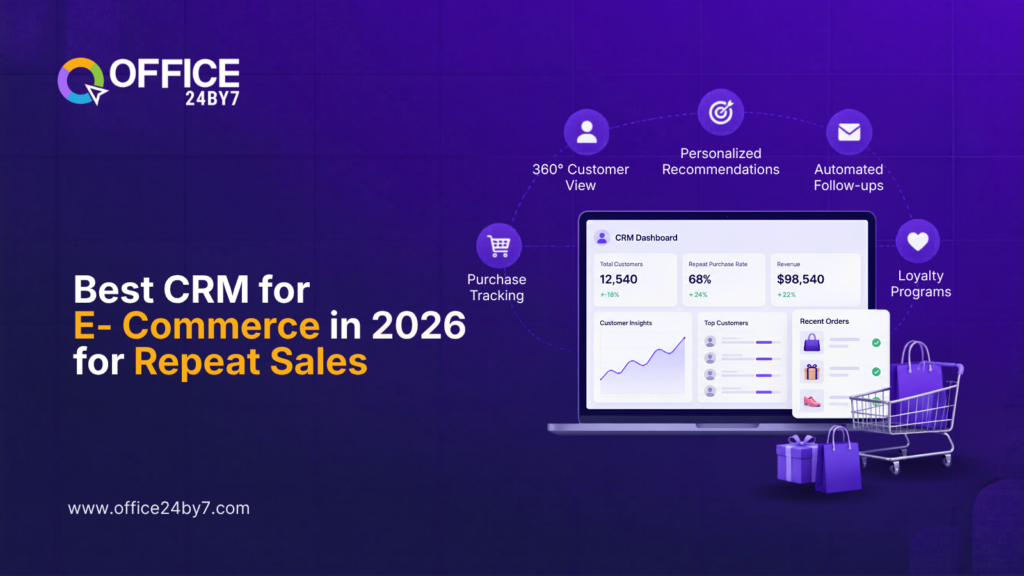
The right CRM for eCommerce changes that all. It turns every purchase into a future sales opportunity by engaging with customers throughout the buying cycle with data-driven, personalised interactions.
How CRM for eCommerce Increases Customer Lifetime Value
Customer lifetime value is the figure that makes eCommerce businesses profitable, not the other way around. It’s tracked by most businesses. Very few actively manage it, as managing it requires being familiar with each customer to the point of engaging them at the right time.
In the context of a customer retention CRM system, lead nurturing involves identifying that a customer who purchased a shampoo three weeks ago is probably in need of a new shampoo bottle. It involves sending a relevant bundle offer to a customer who always purchases in a particular category.
It also means being aware when engagement is declining and taking action before the customer walks away.
These behavioural signals are automatically surfaced in analytics dashboards so that your marketing team can act on real insights, not on scheduled campaigns based on assumptions.
How CRM for eCommerce Reduces Cart Abandonment
Baymard Institute’s 2025 checkout usability research shows that the average global checkout abandonment rate is still over 70%. About 7 out of 10 of the customers who got to your checkout didn’t complete their purchase.
If you don’t have a CRM linked to your eCommerce platform, your customers may leave, and you won’t be able to reach them.
This is where WhatsApp automation comes in handy. The CRM sends a personalised message to the customer via WhatsApp, email or SMS when the product is still fresh in the customer’s mind, and their buying intent is still active, abandoning the cart.
In case one channel fails to respond, the CRM will automatically send the next message at the correct time without disturbing the customer or interrupting the conversation.
How CRM for eCommerce Builds Loyalty at Scale
Loyalty is more than just a rewards programme. It’s all of the times your brand feels relevant, personal and interesting to the customer.
With a CRM for online retailers, all of your interactions with customers, from purchases to support emails, browsing to responses to campaigns, are consolidated in one place, allowing you to nurture thousands of customers at once.
Built-in ROI tracking in the CRM reveals which loyalty programs are truly providing ROI and which are providing costs with no return. In the meantime, a robust contact management system ensures that all profiles are kept accurate and up to date, so personalisation is based on what customers actually do, and not on stale segments that don’t reflect actual behaviour.
Why Businesses Lose Repeat Buyers Without CRM for eCommerce
Most ecommerce companies don’t lose back customers due to a single poor experience. They lose them due to lack of interest, spam, lack of follow-up, and from scratch conversations with support.
A CRM for eCommerce solves all these issues at the root and builds trust.
How Disconnected Systems Break Your CRM for eCommerce Strategy
If your eCommerce platform, email tool, support system and communication channels are all separate, each customer interaction begins with a half-truth.
Support does not have access to the customer’s purchase history. An hour ago, the customer raised a support ticket while marketing was sending a campaign. These gaps grow rapidly.
The sales automation software that integrates with your eCommerce CRM automatically takes the appropriate action at the right time in the customer journey. By automating workflows, manual coordination between teams is eliminated, which cuts down on delays, missed follow-ups, and less consistent customer experiences.
How Generic Communication Limits Your CRM for eCommerce Impact
According to McKinsey research, 76% of consumers get frustrated when brands do not provide them with personalised experiences. In eCommerce, that frustration equates to lost subscribers, reduced engagement and frustrated customers that simply don’t return.
A CRM for eCommerce allows for true personalisation on a large scale.
Lead tracking software keeps track of every customer journey, from the products they have been looking at to the pages they have visited, the previous purchases they have made, and how they have behaved. This behavioural data is directly used to feed into SMS marketing automation sequences that are triggered when customers are most likely to respond.
Generic campaigns turn into relevant dialogues. The results of the difference in open rates, click-through rates and conversion rates become measurable within the first few months of implementation.
Key Features of the Best CRM for eCommerce in 2026
The key to distinguishing average and high-performing eCommerce brands is their ability to respond to customer behaviour and integrate systems. The best eCommerce CRM software isn’t just about data storage; it’s about gathering data from all the places customers visit, where they have purchased, how they communicate and interact with your business, and where they seek support, and then having it all in one place so you can reach them at the right time without having to go to them.
The Salesforce State of the Connected Customer report reveals that today’s customers demand speedy responses, personalised interactions and connected communication across channels. Today’s CRM software integrates automation, communication, and customer data management all in one. For instance, if a customer revisits a product page or leaves the cart, the CRM should automatically follow up with the next step, saving the need for manual tracking.
Essential Capabilities Every CRM for eCommerce Should Include
- Click-to-call software can be used to enable sales teams to instantly reach high-intent customers directly from the CRM. For instance, after a customer has looked at pricing or abandoned a cart, the team can reach out to them right away without having to switch tools or lose the context of the customer.
- The missed call alert system makes sure that no customer enquiries are left unanswered. To prevent lead leakage, the CRM sends a callback notification or follow-up workflow to the customer when the agents are busy or their call comes in outside of business hours.
- Customer support systems are organised through ticketing management systems that connect customer complaints, requests, and resolutions to the right customer profile. As a result, teams gain a full view of past interactions while also improving the quality and speed of their responses and resolutions.
- Voice broadcasting services enable businesses to deliver mass communications like flash sales, loyalty promotions, payment reminders, or back-in-stock notifications via automated voice communication, particularly effective for high-volume eCommerce businesses and campaigns targeting specific regions.
By running these systems from a single connected CRM for an eCommerce system, businesses can not only decrease delays but also enhance client experience and guarantee uniform client interaction throughout the entire client journey.
What Happens With vs Without CRM for eCommerce
| Without CRM | With CRM for eCommerce |
| Generic marketing campaigns | Personalised customer journeys |
| Lost abandoned carts | Automated recovery workflows |
| Fragmented customer data | Unified customer profiles |
| Manual follow-ups | Automated omnichannel engagement |
| High acquisition dependency | Higher repeat purchase rates |
| Inconsistent customer experience | Continuous lifecycle engagement |
How CRM for eCommerce Supports Scalable Revenue Growth
The top eCommerce companies of 2026 don’t view CRM for eCommerce as a mere software application. Rather, they leverage it as the system that integrates acquisition, conversion, retention, customer support, and long-term growth into a single revenue machine.
Customers in today’s day and age use multiple channels in their purchasing journey. They might find a product in an advertisement, do some research on your website, ask questions on WhatsApp, leave the cart, and then come back and purchase the product after receiving a follow-up message or call. These customer journeys are lost between teams and tools, and valuable revenue opportunities are lost without a connected CRM system.
Modern CRM platforms are increasingly using behavioural and purchase data to help businesses identify customer engagement patterns, improve retention efforts, and, consequently, automate more timely customer communication.
How CRM for eCommerce Improves Customer Retention and Repeat Sales
Acquiring customers is becoming more expensive every year. Shopify and HubSpot have recently researched customer retention, and it continues to reveal that retaining customers is much cheaper than continually acquiring new ones.
It’s here that CRM for eCommerce makes a tangible difference to the business.
Instead of sending out generic discounts to all customers in the database, outbound marketing automation enables businesses to reach out to customers who are not buying, but are browsing based on their actual browsing history, purchase behaviour, and engagement patterns.
For instance, a customer may have been ordering skin care products on a regular basis every two months but suddenly stops ordering, and a CRM system can help to get them back. With the right reminders, loyalty offers, and/or replenishment campaigns, businesses can target these customers automatically at the right time.
Such timely and relevant interaction can lead to businesses boosting repeat sales and long-term customer loyalty.
How CRM for eCommerce Supports Upselling and Cross-Selling
The best CRM for eCommerce platforms don’t merely enable businesses to sell more products. Instead, they assist businesses in making more pertinent product suggestions.
Upselling and cross-selling tools built into CRM analysis use several data points, including purchase history, browsing behaviour, order value and customer interests, to automatically provide the most relevant suggestions.
For example, CRM systems can recommend accessories and related products after smartphone purchases.
Personalised recommendations improve customer satisfaction and increase the chances of additional purchases. Because recommendations use real customer behaviour, engagement and conversion rates often perform much better.
Why Omnichannel Communication Strengthens CRM for eCommerce
The communication system that supports the CRM is just as important as the CRM itself. Customers expect consistent communication across phone calls, WhatsApp, SMS, email, and website enquiries.
The ideal eCommerce communication setup for a full CRM should contain:
- Mobile CRM access,
- Cloud telephony services,
- IVR services,
- Virtual number support,
- Omnichannel communication processes.
Customers expect consistent communication across phone calls, WhatsApp, SMS, email, and website enquiries.
For example, when customers call after a WhatsApp campaign, support teams can instantly view:
- Previous purchases,
- Campaign interactions,
- Open tickets,
- Communication history
Without having to ask the customer to repeat information.
This not only results in a quicker, more personalised customer experience, but also enhances the internal efficiency of the operations.
Why Office24by7 Is the Right CRM for eCommerce Fit
Businesses need a CRM that combines automation, communication, support, and behavioural data into one ecosystem. In this regard, Office24by7 combines these features into a single platform designed for expanding eCommerce companies. By connecting these systems into one record, teams can manage every interaction from one place.
With multiple disconnected systems to support, market, call, automate and engage customers, businesses can manage all from one single interface.
Office24by7 is a scalable SaaS solution that integrates quickly with existing eCommerce workflows. Its subscription model helps businesses scale communication channels, automation features, and users gradually.
In-built lead generation software automatically forwards incoming enquiries to the right nurture workflows, from the initial contact. Meanwhile, the wider CRM landscape helps with retention, growth, support, and post-purchase engagement, all from the same connected customer record.
Office24by7 combines WhatsApp, email, SMS, IVR, voice calls, and campaigns into one platform. As a result, this all-encompassing visibility can help businesses enhance customer experience, decrease response time, and foster long-term customer loyalty.
Conclusion
Repeat buyers don’t just stop buying and vanish. They leave when the experience is no longer relevant, personal or of interest.
An eCommerce CRM doesn’t allow that to happen on a large scale. It combines purchases, interactions, and behavioural signals into one customer view for timely engagement.
Not all e-commerce businesses that make the most money in 2026 invest heavily in acquiring new customers. Instead, the ones that succeed are those who keep their loyal customers more consistently and easily than their competitors.
Ready to improve customer retention with CRM for eCommerce?
Office24by7 enables eCommerce companies to bring together all customer interactions, automation, engagement and retention in a single connected platform. Call us at: +91-7097171717 or Email us at: sales@office24by7.com.