Try our 1-minute short audio summary of this blog on How Agentic AI Is Changing CRM Beyond Chatbots. 🎧
For most of the past decade, AI in CRM meant a chatbot quietly sitting in the corner of a website, answering FAQs and occasionally collecting a contact detail. It was useful, but mostly passive. It waited for someone to type a question, gave a scripted answer, and stopped there. Anything beyond that simple exchange still needed a human to step in.
That era is ending faster than most businesses expected. But now the industry increasingly considers agentic AI a separate category from traditional AI assistants and chatbots, and expects enterprise adoption to increase quickly by 2026. This isn’t a minor product update. It’s about the shift in how businesses expect software to perform, and CRM software is at the heart of it. For many sales and support teams, the real problem was never a lack of data. It was the amount of repetitive work required to act on that data consistently every day.
To understand why this shift matters, it helps to look at the difference between an AI agent and a chatbot.
What Separates an Agentic AI from a Chatbot?
These days, the term “AI” is used for virtually anything, and it’s easy to overlook the difference between a chatbot and an agent, but there is a difference.
Chatbots Respond, Agents Execute
A chatbot responds when someone asks a question, providing an answer according to rules or a script. It doesn’t recall much except the conversation at hand, and it can’t act on its own. Gartner, however, has a different definition of AI agents: They are goal-driven software agents that employ AI techniques to perceive, make decisions, take actions, and accomplish goals. An agent doesn’t simply tell a sales representative that a lead looks promising. That shift matters because most CRM teams already know which leads look good. The bottleneck is usually the follow-up work that happens afterward.
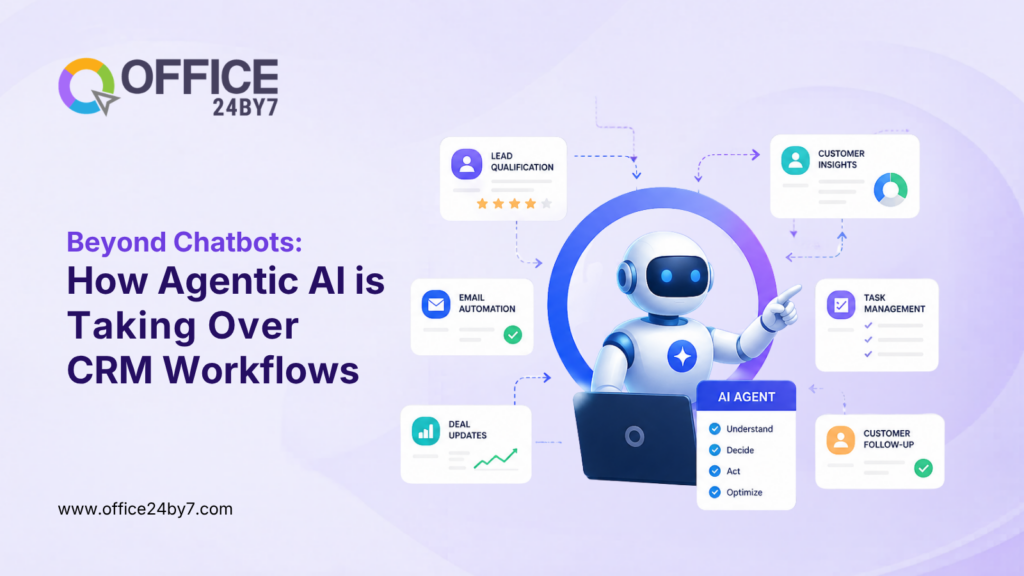
It brings up the lead’s history, drafts a follow-up email, schedules a call, and updates the deal stage in the CRM, without anyone having to click on five different screens.
The Read Path vs the Write Path
The difference is in the location of the work. A chatbot works on the “read path,” which is primarily about analysing and summarising information. An agent works on the ‘write path,’ executing workflow automation, updating records in real systems, and powering modern sales automation software. That’s the real difference between a tool that discusses your CRM data and one that works within your CRM.

Related Reading
How AI in CRM Used to Work
To grasp where this technology is going, it’s important to be honest about where it began; the distance between the two may be greater than people think.
Rule-Based Chatbots and Scripted Responses
During the majority of the 2010s and early 2020s, AI within CRM meant mostly decision tree and keyword-matching chatbots. According to a Gartner survey of customers early this year, 54% of organisations were utilizing some type of chatbot or conversational AI platform for customer-facing work. Adoption appeared to be strong on the surface, but when a question became slightly more complex, these tools were able to respond to FAQs, collect basic contact information, and direct the conversation to a human. They were unable to learn from interactions that had already taken place or take action within the CRM system itself.
Predictive Scoring – Still Required a Human to Act
Predictive lead scoring was the other big application of AI in CRM at this time. This involved a system that studied a contact’s actions and rated them with a score that suggested their likelihood of conversion. This was a very helpful feature, and it’s one of the reasons why platforms that have features such as Salesforce’s Einstein scoring engine and modern lead tracker software exist. It did have clear limitations, though.
The AI was able to identify the lead to call first. It was not able to make the call, write the email, or update the record afterwards. Every insight still had to pass through a human before anything actually happened.
In practice, this often meant sales teams had dashboards full of insights but still relied on manual follow-ups, spreadsheets, and reminders to move deals forward.
How Agentic AI Is Used in CRM Now
This is where 2026 is very different from even two or three years ago. The intelligence hasn’t just gotten smarter. It’s started acting.
Lead Qualification & Routing
An agent can now evaluate behavioral signals, assign a priority score, and route the lead to the right agent, before a human opens their inbox, instead of a sales representative manually reviewing every inbound lead and deciding who should follow up. The scoring step hasn’t disappeared. The only thing that has changed is that the system is no longer limited to scoring; it reacts to the score.
For example, a missed-call recovery workflow can now create a lead automatically, trigger a WhatsApp follow-up, and notify a sales representative within seconds.
Follow-Up and Meeting Handling
With AI platforms, cloud telephony services, and modern integration frameworks, agents can easily connect to external tools and data. That enables them to access a customer’s record from a CRM, see calendar availability, note down a meeting summary following a call, and update the next steps in a deal.
They can accomplish all this with a single connection, rather than several manual integrations. This infrastructure has been built out very rapidly, and a growing ecosystem of MCP-compatible connectors and integrations is emerging across enterprise systems. This includes integration with mobile CRM, click-to-call software, task management systems, and enterprise analytics dashboards.
A few years ago, connecting these systems usually required multiple tools and custom integrations. Now, many businesses expect these workflows to operate almost in real time.
Customer Service that Resolves, Not Just Deflects
The biggest difference from the previous chatbot era is in customer service. Industry analysts predict that agentic AI could automate a significant portion of routine customer service tasks by 2029, potentially reducing operational workload significantly. “The keyword here is ‘resolve,’ not ‘deflect.’ Where the chatbot era could only point a customer toward an article, a modern agent can:
- See a customer’s order history and track order shipments in real time.
- Handle a simple refund/rebook without escalation
- Automatically update the CRM record when the issue is closed
- Only escalate to a human when it is truly necessary to use judgment.
That distinction is important because customers generally do not mind automation when the issue is resolved quickly. Frustration usually begins when automation creates delays instead of removing them.
This is the type of layered automation that CRM platforms are working towards in IVR services, WhatsApp automation, and cloud telephony services, where the idea isn’t to have a chatbot attached to the side of the system but to have workflows that respond to a customer’s actual record as soon as a call, message, or missed call arrives.
Why 2026 Marks a Real Turning Point
With the 2011 prediction so wrong, it’s reasonable to wonder why this one is to be believed. The answer is within the numbers.
The Spending Numbers
Gartner also forecasts that by the end of 2026, 40% of enterprise applications will contain task-specific AI agents, compared to less than 5% in 2025. This is not gradual adoption. Enterprise software itself is changing shape within a single year. Meanwhile, the investment in chatbots will remain steady as enterprise investment in AI moves toward more autonomous, workflow-based systems over the next few years.
Real Revenue Evidence from Salesforce Agentforce
This new wave is not the same as the old prediction, as it has real revenue to support it. Platforms like Salesforce Agentforce reflect growing enterprise interest in agentic AI workflows. One vendor and one product line already show that businesses are moving beyond experimentation. Several companies are now integrating their sales automation applications, lead generation software, and marketing automation platforms into a single customer workflow.
The broader trend is that businesses are no longer evaluating AI tools separately. They are evaluating whether the entire workflow moves faster with fewer manual steps.
Related Reading
What This Means for CRM Teams Going Forward
Not every AI implementation succeeds, but if it were, the predictions made in 2011 would have been even worse than they actually were.
Where Agentic AI Delivers Real Value
Gartner estimates that over 40% of agentic AI projects will be abandoned before 2027, with most of these failures coming due to rising costs, business value uncertainty, and poor governance as projects transition from pilot to production. There are several habits that the businesses that are succeeding despite those odds have in common. They:
- Don’t start with a broad objective like “manage customer relationships”, but rather a specific objective like lead follow-up, drip marketing automation, or missed call recovery.
- Compare results to a defined baseline before scaling to a second use case.
- The companies seeing the best results usually start with one repetitive process that already consumes a large amount of team time.
- Keep a human in the loop for exceptions and high-stakes decisions rather than aiming for full automation immediately.
Conclusion
Clean CRM data is more important than ever. Agents working with messy or duplicate records tend to make mistakes quickly. However, Gartner has noted that a future without human customer service isn’t likely. Most Fortune 500 companies are still expected to retain human customer support alongside AI systems. The realistic approach is a mix of both humans and technology. Most organisations aim to reduce repetitive tasks so that employees can focus on important decisions that need experience or context.
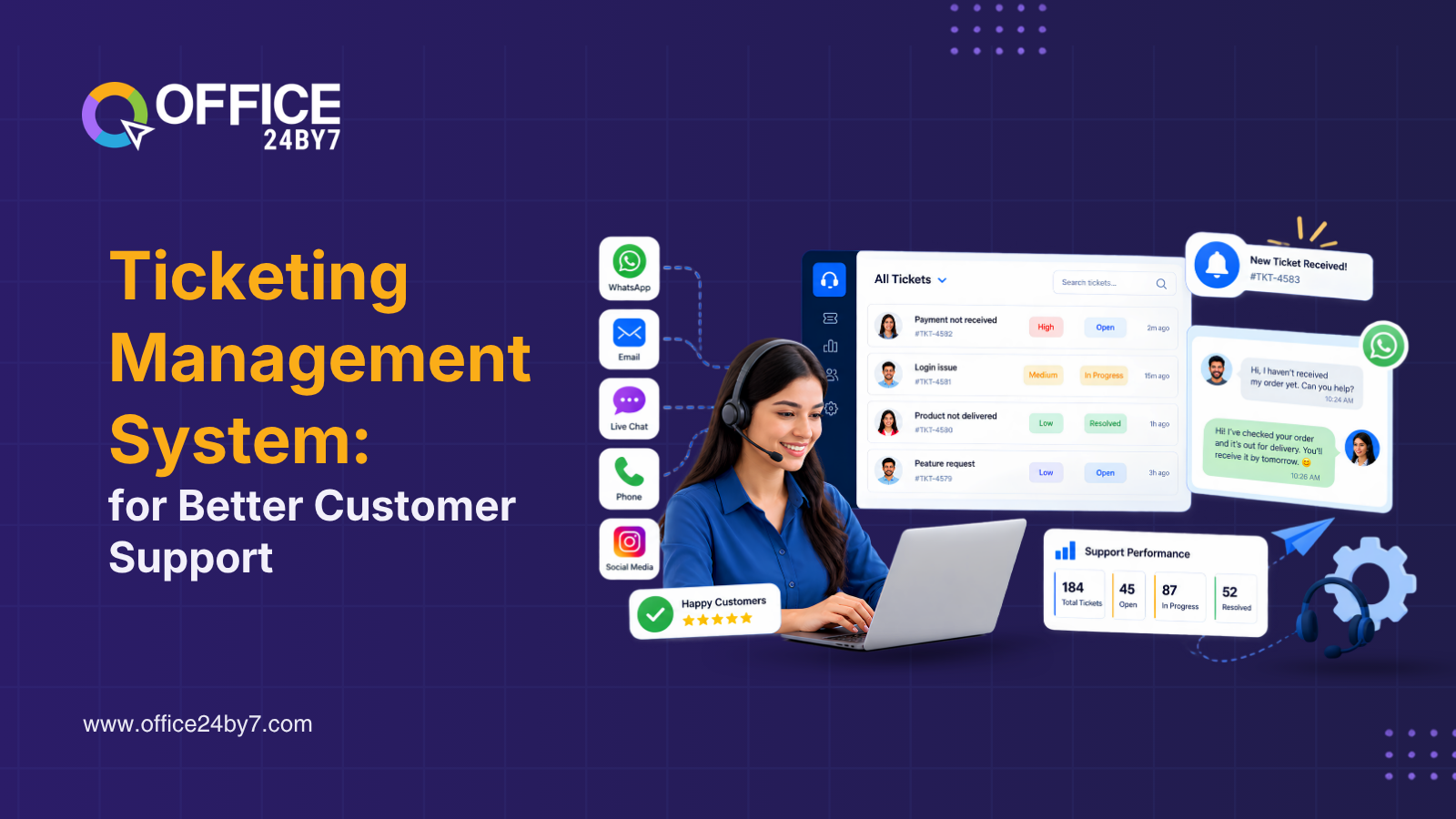
Teams can handle issues more effectively with integrated ticketing management systems and marketing platforms that use many channels. Humans can deal with exceptions that truly require judgment.
Chatbots will continue to be a part of customer service, especially for basic FAQ responses on websites. However, they are no longer the best option for more complex CRM tasks. Earlier promises of chatbot automation were not met due to technological limitations. Now, we have actual spending figures, revenue numbers, and failure rates to consider. For many businesses, the best strategy is not to replace teams completely with AI agents. Instead, they should find the repetitive tasks that slow teams down and decide which ones can be automated first.
Empower yourself to manage your CRM data effectively starting today. Call us at: +91-7097171717 or email us at: sales@office24by7.com.
Visit: www.office24by7.com for more information.