Try our 1-minute short audio summary of this blog. 🎧
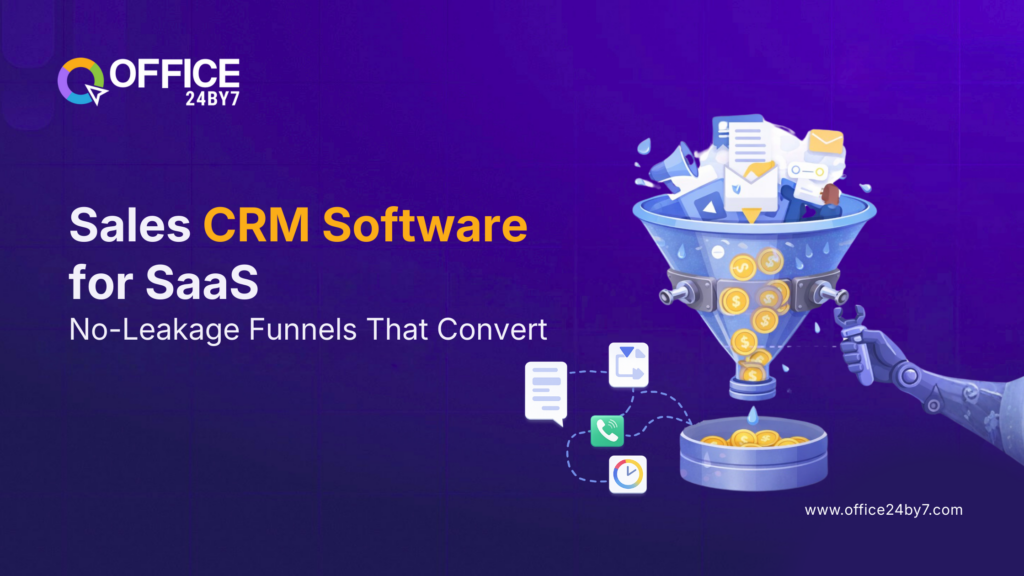
According to OpenView’s Product Benchmarks Report, free trial conversion rates for B2B SaaS typically range from 15% to 17%. That means roughly 80–85% of trial users walk away without ever paying, not because the product failed them, but because the system around the trial did. Sales CRM software built for SaaS is designed to close that gap, and every other one like it, across the full customer lifecycle.
The SaaS revenue model is stricter than the traditional B2B sales. Each stage, trial, conversion, onboarding, renewal, and expansion has its share of leakage risk. A follow-up missed at trial, a renewal check-in skipped, an expansion signal not surfaced; all these things are a silent killer of what ARR (annual recurring revenue) the business is counting on.
Most SaaS teams will patch these gaps manually, inconsistently, or not patch them at all. They employ additional agents, conduct more campaigns, introduce more tools, and still see revenue decline at each step. The fix is not more effort. It has superior infrastructure.
This blog explains where the SaaS sales funnel leaks, how sales CRM software closes each gap, and what a no-leakage model looks like in practice, from first trial through renewal and expansion.

Related Reading
- How Sales CRM Software and Automation Benefit SaaS Companies
- How CRM Improves Sales Productivity for SaaS Teams
- Closing the Trial-to-Paid Gap With Sales CRM Software
- Sales Follow-Up Automation: What Most SaaS Teams Still Get Wrong
- Preventing Revenue Loss at Renewal and Expansion With Sales CRM Software
- The Data Foundation Sales CRM Software Cannot Function Without
- Measuring Whether Sales CRM Software Is Closing the Leaks
- Conclusion
How Sales CRM Software and Automation Benefit SaaS Companies
Before explaining how sales CRM software works, it’s important to understand why SaaS companies need it. We should also look at the changes that happen when they use it effectively.
The business outcomes are direct and quantifiable. According to Salesforce, organizations using CRM with sales automation see an average 29% increase in sales revenue and a 34% improvement in sales productivity. For a SaaS company managing trials, renewals, and expansion simultaneously, these gains compound across every revenue stage, not just at acquisition.
Beyond revenue, the operational clarity that comes with sales CRM software changes how leadership makes decisions. Instead of relying on gut feel and weekly pipeline reviews, revenue leaders get a real-time view of where accounts stand, which trials are at risk, and which customers are approaching renewal. Using the same CRM platform for both marketing and sales automation reduces the friction that can cause leads to be lost between teams.
How CRM Improves Sales Productivity for SaaS Teams
The business case for sales CRM software is clear. The more practical question for SaaS operators is: what does it actually change inside the team’s daily work?
Lead Scoring, Segmentation, and Pipeline Visibility in Sales CRM Software
Sales CRM software makes it easier for SaaS teams to manage leads more intelligently, spending less on equal effort and more on prioritized effort. Automatic lead scoring is scoring based on two dimensions at once: acquisition signals, company size, trial source, and pricing tier, as well as behavioral signals, feature activation, login frequency, and team invitations sent. The total score informs agents of who is near to convert, who needs a structured nudge, and who entered the trial with no real purchasing intent.
Without this, agents spread out equal attention over unequal opportunities. A free-tier signup agent in 40 minutes with no engagement may instead have spent that time at a high-fit, high-intent account that visited the pricing page three times this past week. Segmentation adds to this; a solo founder and an enterprise vice president of operations require completely different messaging, timelines, and obstacles addressed. Sales CRM software tags and routes each lead at the point of entry so that the right sequence of leads gets to the right person, automatically.
Follow-Up automation and Lifecycle Tracking in Sales CRM Software
Where sales CRM software changes day-to-day work the most is in follow-up and lifecycle tracking. Every interaction, trial initiated, feature triggered, calls made, proposals sent, renewals coming up, and logs to the CRM are updated automatically without needing to be typed in manually. agents begin every day with a list of prioritized actions, rather than a blank screen.
Real-time analytics dashboards surface which accounts are at risk, which are showing expansion signals, and what needs attention today. This is where marketing automation and sales automation converge in a SaaS context: the CRM doesn’t just track what happened, it tells the team what to do next. For SaaS teams using click-to-call software integrated with the CRM, every outbound call logs instantly, keeping pipeline data current without any agent effort.
Closing the Trial-to-Paid Gap With Sales CRM Software
The moment a user starts a free trial, a race begins. SaaS companies that guide users to core features within the first session see materially higher retention and conversion performance. Sales CRM software stops that clock from running out unnoticed.
What Sales CRM Software Triggers at the Trial Entry Point
When a customer is in the trial period of the CRM software, a properly configured sales CRM fires automatically, without waiting for an agent to notice. The user’s source, company size, role, and stated use case are captured and pushed immediately into a relevant nurture track. A personalized onboarding email goes out within minutes. High-scoring accounts alert the assigned agent in real time. Product usage data begins flowing back into the CRM automatically.
Without this, the default sequence is: trial starts, a generic welcome email lands, and then silence for three days. By then, the intent of the user has already changed. The automation breaks that silence with thought-out, behavior-timed engagement, sequences that are based on what the user does, not just when he or she signed up.
In more advanced SaaS environments, this logic is carried into omnichannel marketing, where email, in-app prompts, sales outreach, and automated IVR service follow-ups are all working from a single CRM workflow, and not a single trial user is missed in any channel.
Sales Follow-Up Automation: What Most SaaS Teams Still Get Wrong
Manual follow-up fails in SaaS for the same reason it fails everywhere: arithmetic. An agent managing active trials, live pipeline, and renewal accounts simultaneously cannot maintain five or more meaningful touchpoints across all of them. In SaaS, what gets dropped is typically the trial user who needed at least two more contacts to convert.
The Cost of Missed Follow-Ups Without Sales CRM Software
According to The Brevet Group, 80% of sales require at least five follow-up attempts after the first meeting. Yet 44% of sales agents stop after just one. In SaaS, that abandonment is particularly costly; trial windows are short, intent decays fast, and the user making the evaluation is often fielding demos from three competitors simultaneously.
Sales CRM software helps ensure that follow-up happens consistently, regardless of who is on the sales team. When a software trial user starts using the CRM, the system automatically begins a series of steps:
- Step 1: It sends a message on day one,
- Step 2: a helpful email on day three,
- Step 3: a targeted SMS or other outreach on day five,
- If there is no response,
- Step 4: a relevant case study on day eight, and
- Step 5: a final message focused on converting the user on day twelve.
The agent only gets notified when behavioral signals, repeated pricing visits, and deep feature engagement indicate that a human conversation will accelerate the decision.
According to The Annuitas Group, as cited by HubSpot, businesses using automation to nurture prospects see a 451% increase in qualified leads. In SaaS, that means more trial users arriving at the sales conversation already engaged and already closer to a decision.
Related Reading
How Behavioral Segmentation in Sales CRM Software Increases SaaS Conversions
Not every trial user should receive the same sequence. A solo founder evaluating a SaaS platform for personal productivity has different needs, a different timeline, and different objections than a VP of Operations trialing the same platform for a 200-person team. Sales CRM software segments users at entry, by company size, role, stated use case, and product behavior, and routes each into the sequence built specifically for their context.
This distinction separates automation that converts from automation that generates unsubscribes. Lead nurturing built around behavioral segmentation creates better-onboarded customers who see value faster, expand more readily, and churn less. When click-to-call software is integrated with the CRM, agents can reach high-intent segments instantly, with full context loaded before the call connects. The full customer lifecycle improves when early-stage automation is built around relevance, not volume.
What SaaS Teams Recover When Sales CRM Software Handles Follow-Up
According to Salesforce, sales teams save more than six hours per week per agent when follow-up sequences run through sales automation services. In SaaS, that time goes back into the conversations that need real human judgment: live demos with interested trial users, expansion discussions with decision makers, and renewal conversations with accounts showing early churn signals.
For SaaS teams handling higher trial volumes, integrating cloud telephony services with the CRM ensures every call, voicemail, and conversation log enters the pipeline automatically, giving managers full lifecycle visibility without adding manual reporting work. The division of labor becomes clear: automation handles the systematic, repeatable work; people handle the high-value moments.
Preventing Revenue Loss at Renewal and Expansion With Sales CRM Software
The most expensive customer in SaaS is the one lost at renewal. The subscription model means every cancellation is not just a lost sale; it is a permanent reduction in recurring revenue. Acquiring a new B2B customer typically costs five to seven times more than retaining an existing one. The first renewal is not just a revenue event; it is the moment a customer becomes profitable.
Yet most SaaS teams manage renewals reactively, manually, and too late. An account manager notices the contract is up in two weeks and sends a check-in email. By then, the customer has often already made their decision. Sales CRM software changes this by treating the post-sale customer lifecycle with the same operational discipline as the pre-sale pipeline. For larger SaaS accounts, renewal workflows can also include an IVR system tied to the sales CRM software, allowing customers to reach the correct account or support team immediately during critical renewal windows, while every interaction is tracked as a retention signal.
Renewal alerts fire 90 days before a contract ends, not ten days. Expansion triggers activate when product usage crosses thresholds that historically precede upsell conversations. Health score drops, declining logins, reduced feature usage, unresolved support tickets, trigger automated check-in sequences before a customer decides to cancel without notice. According to Bain & Company, as cited in Harvard Business Review, a 5% improvement in customer retention increases profits by 25% to 95%. Sales CRM software makes proactive, data-driven retention operationally realistic for growing teams, without proportional headcount increases.
The Data Foundation Sales CRM Software Cannot Function Without
CRM automation relies on the quality of the data in the system. In the SaaS industry, where user behavior drives automation, poor data can cause serious problems. If product usage data does not sync well with the CRM software, it can lead to incorrect user segments. If trial start dates are recorded incorrectly, timing-based actions can fail. And, if account ownership isn’t assigned when someone signs up, follow-ups may never happen.
Three customer data management practices protect that foundation.
- Real-time enrichment at trial signup pulls company size, industry, and role automatically so agents have full context before the first conversation.
- Native integration between the Sales CRM software and product analytics tools ensures usage signals flow without manual exports.
- Monthly hygiene reviews catch duplicates from multiple signups, contacts with zero engagement, and accounts where product data has stopped syncing.
The marketing automation and sales automation logic inside any SaaS platform only works well when it runs on accurate, current data. This is not optional; it determines whether every automation decision generates results or compounds errors.
Measuring Whether Sales CRM Software Is Closing the Leaks
Building a no-leakage funnel and confirming that it works are two different challenges.
Four metrics tell SaaS leaders what is actually happening, no manual report required.
- Trial-to-paid conversion rate by cohort shows whether sales CRM software is moving trial users to paid at a meaningful rate. Industry benchmarks from OpenView and Recurly consistently show that B2B SaaS trial-to-paid conversion rates typically fall between 15% and 25%, depending on onboarding quality and pricing structure. Sitting consistently below that on a well-defined ICP signals that nurture sequences are not engaging the right users early enough.
- Time-to-conversion measures how many days pass from trial signup to paid status. As sales automation matures, this number should decrease. If it does not, the automation is running but not removing the friction that slows decisions.
- Net Revenue Retention tracks whether existing customers are growing or declining in revenue value. Top-performing SaaS companies maintain NRR above 100%, meaning expansion revenue consistently outpaces churn, a direct outcome of Sales CRM software actively managing the renewal and expansion stages of the customer lifecycle.
- ROI tracking closes the loop. Sales cycle length captures how quickly motions close. According to Nucleus Research, CRM automation shortens sales cycles by 8 to 14%.
In SaaS, that compression means more accounts closed per quarter by the same team. A well-configured CRM analytics dashboard surfaces all four metrics simultaneously, and leadership stops guessing and starts seeing.
Conclusion
SaaS companies don’t lose revenue in a single dramatic failure. They lose it gradually, in trials that don’t get the right follow-up, in renewals that slip past unnoticed, in expansion opportunities that no one surfaces in time.
Sales CRM software for SaaS addresses all of it structurally. Trial users receive behavior-triggered sequences from the moment they sign up. Follow-up runs are systematic regardless of agent bandwidth. Lead scoring surfaces the highest-intent accounts before the window closes. Renewal alerts are sent months early. Expansion signals reach agents before customers think to ask. The teams that get this right don’t just close more trials. They build a system where losing revenue to process failure stops being normal. The no-leakage SaaS funnel isn’t a goal; it’s a system decision.
Office24by7 CRM brings together trial tracking, behavioral automation, customer lifecycle management, and real-time analytics dashboards in one platform built for SaaS teams that cannot afford to lose revenue at any stage. If your SaaS team is still managing trials, renewals, and expansion in disconnected tools, this is where revenue leakage quietly begins.
This is where most SaaS funnels leak revenue. A lifecycle-aware CRM prevents it.
Ready to plug your SaaS funnel leaks? Book a quick Office24by7 demo and see no-leakage automation in action. Call us at +91-7097171717 or email sales@office24by7.com and transform your growth strategy today.