Try our 1-minute short audio summary of this blog on Build a High-Converting Sales Pipeline. 🎧
Today’s sales teams manage leads on the phone, via email, websites, social media, and messaging. But there are still many businesses that find it difficult to arrange opportunities correctly. Consequently, follow-ups become sporadic, leads go cold, and conversion rates begin to fall. This is where a structured sales pipeline comes in handy. Businesses can leverage Office24by7 Sales CRM software to manage deals, streamline workflows, and gain visibility throughout the sales process, rather than relying on spreadsheets or disjointed tools. Furthermore, a well-managed pipeline enables teams to focus on high-intent leads, keep the communication streamlined, and speed up the deal closure without adding unnecessary complexity.

Related Reading
- Why a Well-Structured Sales Pipeline Improves Conversions
- Understanding the Stages of a High-Converting Sales Pipeline
- How to Build a Sales Pipeline in Office24by7 CRM
- Common Sales CRM Pipeline Mistakes That Hurt CRM Performance
- Best Practices for Managing and Optimizing Your Sales Pipeline
- How Office24by7 CRM Helps Businesses Build Smarter Sales Pipeline Workflows
- Conclusion
Why a Well-Structured Sales Pipeline Improves Conversions
A well-structured pipeline provides sales teams with a full view of all opportunities. Teams can keep track of interactions, be aware of progress, and react more quickly rather than guessing where a lead is. As a result, businesses cut down on delays and enhance consistency in conversion throughout the sales process.
- A structured deal pipeline enables teams to keep track of leads without losing sight of them.
- Faster follow-ups improve customer engagement and response rates.
- Clear deal stages enable teams to focus on high-intent deals.
- CRM workflows cut down on manual tasks and increase accountability.
- Automation prevents leads from slipping through communication gaps.
- Improved visibility enables managers to monitor deal aging, follow up timelines, make more accurate forecasts, and spot follow-up delays before opportunities go cold.
- Organized processes boost the rate of CRM adoption in sales teams.
- Centralized communication makes it easier to work together between departments.
Often, businesses miss out on opportunities because sales agents use several tools to manage information. But Office24by7 CRM brings all the customer interactions to a single place, which makes it easier to manage conversations and activities from a single platform. Moreover, combined cloud telephony services enable groups to get in touch with prospects in no time at all and keep communication records within the CRM.
A structured process also enhances decision-making. Managers can uncover opportunities that are not moving, evaluate pipeline performance, and better lead teams. Moreover, businesses can integrate pipeline workflows into sales automation to assign leads, set reminders, and send notifications automatically. This eliminates the need for manual follow-ups and ensures consistency of operations over time.
Studies cited in several sales books have shown that companies that follow up leads within five minutes are much more likely to qualify and convert leads than those that take longer. This is a good example of the importance of automated reminders, instant lead routing, and centralized CRM workflows for conversion rates.
Understanding the Stages of a High-Converting Sales Pipeline
A well-structured sales process ensures that businesses follow up consistently, gain visibility, and close deals more efficiently. The CRM platform can help sales teams to streamline their processes, improve communication, and keep track of the entire customer journey, all of which contribute to successful deal closures.
Lead Capture and Qualification in a Sales Pipeline
All successful opportunity pipelines begin with a structured lead capture process. Leads are generated for businesses through websites, advertisements, referrals, calls, and campaigns. But if there isn’t a clear qualification process, salespeople spend time with prospects who aren’t ready to buy.
Centralized CRM workflows enable companies to gather and arrange leads from a number of channels into a single location. This means teams can act more quickly and stay on the customer’s radar throughout the customer journey. Furthermore, the easier it will be to qualify leads if sales agents establish clear lead qualification criteria that include budget, interest, industry, or buying intent.
A lead should only progress to the next stage if it fulfils specific criteria. This stage discipline helps to maintain a smooth conversion process and avoid any potential confusion later in the process. Moreover, companies can add a WhatsApp chatbot to their websites to connect with visitors in real-time and automatically record their questions, without having to wait.
Sales Engagement and Opportunity Management in a Sales Pipeline
After teams qualify leads, they need to stay in touch. Discovery calls, product demos, and follow-ups are a significant part of the process of advancing opportunities. So, businesses require a full view of the customer communication and activity history.
The system allows teams to monitor calls, emails, notes, and tasks within a single dashboard. As a result, representatives are able to follow up on conversations without missing key information. Stage movement guidelines also assist teams in determining if opportunities should move forward in the sales funnel.
Many businesses have deals that go cold for extended periods. But automated reminders and task notifications make sure teams follow up regularly. In addition, inbound call routing is enhanced with integrated IVR services, which allow prospects to reach the right representatives in no time at all.
Proposal, Negotiation, and Deal Closure in a Sales Pipeline
Effective sales coordination and communication are needed in the final stages of a sales pipeline. Prospects will be negotiating prices, looking at competitors, or getting approvals. Thus, sales teams need to be responsive and engage them throughout the process.
The system enables businesses to effectively monitor the progress of negotiations, track proposals, and communicate with stakeholders. This provides teams with greater insight into deal health and likely deal closure dates.
Managers can also detect and prevent deadlocked opportunities. Moreover, activity tracking enables businesses to know what activities are most effective for successful conversions. When businesses integrate customer services like the ticketing management system into their workflows, they can also address customer concerns quickly during the decision-making process.
How to Build a Sales Pipeline in Office24by7 CRM
A strong sales pipeline is crucial for any company aiming to optimize its sales process and improve customer relationships. This guide will show you how to get the solution to work effectively to establish a sales process.
Structuring Sales Pipeline Stages and Sales Workflows
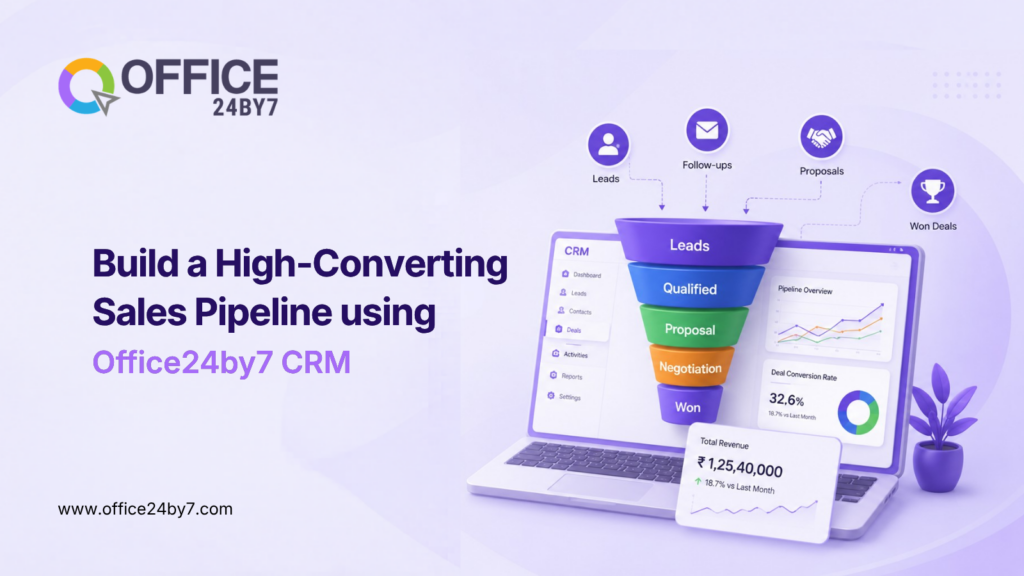
The first step in creating a successful pipeline workflow is to establish realistic stages that align with the business sales cycle. Businesses should make sure to keep things simple and clear instead of introducing too many stages. The majority of organizations are more effective when they have 5-7 clear stages.
It is important to have explicit entry and exit conditions at each stage. For instance, a lead should move from qualification to engagement only after confirming genuine interest or scheduling a discovery call. This organized method increases accountability and decreases confusion in the sales group.
Businesses can tailor pipeline stages to their workflows with the system. Within each stage, teams can own tasks, schedule them, and keep all communication history. As a result, representatives have a full picture of the customer interactions, without having to navigate between various systems.
An IVR system can also be integrated with CRM workflows to enhance lead routing and minimize delays in customer communication. This will provide a more seamless sales process and increase the efficiency of responses.
Automating Sales Pipeline Activities for Better Conversions
Manual follow-up can lead to bottlenecks in the operation. Sales agents can forget to do something, take a long time to respond, or miss opportunities. But automation can keep businesses consistent throughout the sales pipeline.
Nobody wants to waste hours of their sales team’s time on manual lead assignment. With centralized CRM workflows, businesses can automate lead routing, reminders, notifications, and activity tracking from a single workflow. This means that teams can concentrate more on the selling and less on administrative tasks. Automated workflows also make for faster responses, which directly impact conversion rates.
For instance, once a lead hasn’t interacted with the business for a certain amount of time, they can be alerted automatically. Likewise, CRM workflows can automatically route new inquiries to available representatives. These minor operational enhancements have a big impact over time.
The CRM can automatically send a reminder to the salesperson assigned to the prospect if they download a pricing brochure without contacting them within 48 hours. This helps sales teams reconnect at the right time instead of relying entirely on memory or manual tracking.
Moreover, companies can integrate CRM workflows with click-to-call software to streamline outbound calling and track conversations. Communication data is still centralized, which means managers have more insight into the performance of the team and customer engagement trends.
Common Sales CRM Pipeline Mistakes That Hurt CRM Performance
Effective sales pipeline management is essential to getting the most out of your CRM. But many businesses fail because of common pitfalls that can affect their success. In this section, we’ll discuss these obstacles and how to overcome them to make your sales process smooth and efficient.
Process Gaps That Reduce Sales Process Efficiency
Many companies develop a sales pipeline without having the correct criteria to move a salesperson through the stages. This results in sales reps moving leads up and down, which leads to confusion between teams. As time goes on, the pipeline fills up with leads that are inactive or of poor quality, making it harder to see and predict.
One more frequent problem is delayed follow-ups. If teams are depending on memory or manual tracking, chances are they will miss out on opportunities before they can reach out to prospects. As a result, companies miss out on revenue even if they are getting a lot of leads.
Lack of CRM adoption also has a significant impact on the performance of the pipeline. When representatives don’t update the deal status frequently, managers lose visibility of sales activities and conversion trends. Thus, businesses need to streamline processes and establish clear workflows that can be consistently followed by the teams.
Many organizations don’t pay attention to pipeline reporting. If businesses don’t look at conversion rates, response times, or opportunities that have been stalled, they have a hard time finding areas of weakness. But frequent analysis can help teams make continuous improvements to their sales pipeline and make better decisions.
When businesses use CRM workflows alongside sales automation software tools, they can alleviate many of these challenges. Automated reminders, activity tracking, and centralized communication boost accountability and ensure that teams stay engaged throughout the sales cycle.
Best Practices for Managing and Optimizing Your Sales Pipeline
To keep a sales pipeline running smoothly, it needs to be continuously monitored and optimized. It is best for businesses to regularly check pipeline performance rather than wait for conversion rates to drop. This proactive approach enables teams to find out operational gaps before they impact revenue growth.
- Track conversion rates stage-wise regularly.
- Monitor response times for sales activities.
- Identify stalled opportunities before leads go cold.
- Check pipeline health via CRM dashboards and reports.
- Make workflows easier to adapt to ensure CRM use.
- Further qualify using conversion patterns.
- Stay disciplined with follow-up using automation.
- Use deal velocity as a measure to enhance forecasting.
Another area of focus for businesses is to enhance the consistency of their communication. If representatives go through different processes, customers are delayed and confused. Standardized workflows, however, have the benefit of enhancing the customer experience and ensuring teams remain efficient.
The platform offers centralized dashboards to keep managers informed about activities, conversion trends, and pipeline movement in real-time. This means that decision makers can easily see where the bottlenecks are and can change the workflow if needed.
By incorporating omnichannel marketing into customer communication processes, businesses can enhance engagement even more. They will have instant answers on their favorite platform, which will boost engagement and ensure that no questions go unanswered.
Also, companies that integrate sales CRM workflows with ticketing management systems can ensure better communication and collaboration between the sales and support teams. This enhances customer experience both in the pre-sales and post-sales interactions.
Reorganize your office with Office24by7!

How Office24by7 CRM Helps Businesses Build Smarter Sales Pipeline Workflows
Businesses need to have efficient systems in place to manage and optimize their sales processes. The system provides innovative solutions, simplifying the conversion process and enabling businesses to improve their productivity and growth. Let’s take a look at how this powerful tool can help improve your sales strategy.
Centralized Lead Management and Omnichannel Communication
The CRM allows businesses to handle calls, emails, tasks, and customer interactions from a single place. Sales teams can now view all customer activity in one place, rather than having to switch between different systems.
This centralised approach enhances the collaboration between departments and minimises communication gaps. The sales representatives will be able to see previous interactions at a glance, making it easier to carry on with the conversation. Furthermore, managers can keep track of team performance and pipeline movement without manually reporting.
Automation, Reporting, and Scalability in a Sales Pipeline
Manually tracking opportunities becomes a challenge as businesses scale. That makes automation a key element in ensuring consistency in the sales process.
Businesses can scale efficiently with Office24by7 CRM’s workflow automation, activity tracking, reporting dashboards, and performance analytics. Automated reminders and notifications keep teams up to date and prevent them from relying completely on manual coordination.
Real-time reporting also helps to enhance forecast accuracy. Centralized dashboards allow managers to track conversion rates, pinpoint areas for improvement, and assess sales performance. As a result, businesses make quicker and more informed decisions.
Another way to improve communication processes in organisations is to connect a task management software with CRM operations. This enhances call management and facilitates businesses to have a full record of all tasks for each lead and opportunity.
Conclusion
A sales pipeline provides businesses with a structured approach to sales, allowing them to have better visibility, follow up consistently, and boost conversion rates throughout the sales process. By centralizing opportunities, automating workflows, and streamlining customer interactions, Office24by7 CRM empowers organizations to manage their interactions more effectively.
As businesses establish clear stages in the sales pipeline, track performance over time, and automate repetitive tasks, their sales processes become more robust over time. Furthermore, centralized reporting and communication tracking can aid teams in discovering bottlenecks before they impact conversions.
Office24by7 CRM integrates automation, lead management, reporting, and communication features in a single application to help businesses develop scalable and high-performing sales operations. With smarter CRM workflows, businesses can streamline their opportunity pipeline, enhance engagement, and close deals more consistently, as customer expectations keep changing.
Build a sales pipeline that keeps your team organized, your follow-ups consistent, and your opportunities moving toward conversion with Office24by7 CRM. Call us at: +91-7097171717, email us: sales@office24by7.com, or visit: www.office24by7.com