Try our 1-minute short audio summary of this blog on Agentic AI. 🎧
Most sales teams already use AI to draft emails or summarize customer calls. That saves time, but it stops at the draft. Someone still has to open the CRM, log the call, update the lead, and set a reminder.
Agentic AI is what happens when that last step disappears. A salesperson hangs up, and the CRM software has already read the conversation, figured out what comes next, and done it. No notes, no manual update, no reminder set by hand.
According to Microsoft’s Work Trend Index, 93% of Indian business leaders plan to use AI agents within the next 12 to 18 months. McKinsey’s research shows regular AI use in at least one business function climbed to 88% this year, up from 78% the year before, yet no single business function has more than 10% of organizations scaling AI agents in it. Intent is high. Execution is where most teams stall.
Here’s what agentic AI actually does inside a CRM, and what Indian sales and support teams should figure out before they touch it.
- Why Agentic AI Is the Next Step for Sales Automation Software
- Agentic AI vs Generative AI: What’s the Difference?
- How AI Agents Work Inside a Sales CRM Software Platform
- Where Agentic AI Strengthens Sales, Support, and Marketing Automation
- Why Connected Business Platforms Matter for AI Agents
- What Indian Businesses Need Before Adopting Agentic AI in Sales CRM Software
- Conclusion
Why Agentic AI Is the Next Step for Sales Automation Software
Sales automation software already assigns leads, tracks calls, logs deals. Generative AI stacked a layer on top of that: draft this email, summarize this call. Useful, but it didn’t touch the manual work underneath. Someone still opened the CRM by hand.
Agentic AI removes that manual work. Say a lead writes back, “we’re interested, but we need approval next month.” A normal system just files that sentence away. An agent reads the timeline in it, tags the lead as warm, and books a follow-up for the right week.
A few years ago, this kind of automation belonged to companies with an in-house AI team and the budget to match. Not anymore. Integrated CRM platforms have brought it down to a size a five-person sales team can actually use, which means less time spent on admin and more time spent selling.

Related Reading
Agentic AI vs Generative AI: What’s the Difference?
Rule-based workflow automation is already everywhere in most sales teams: form submitted, email sent; deal stage changed, manager pinged. Fine, as long as every situation fits the same shape. Real conversations rarely do.
Why Traditional Workflows Reach Their Limits
A workflow rule has no idea what “we need approval next month” means. It can’t read intent. An AI agent can: it picks up the interest level, the rough timeline, the logical next step, and acts on it instead of just logging the sentence. Put simply, workflow automation software asks which rule fires. Agentic AI asks what the team is actually trying to get done.
Lined up side by side, the gap between the three is easy to see.
| Aspect | Generative AI | Workflow Automation | Agentic AI |
| Trigger | A user prompt | A predefined event | A business goal |
| Decision-making | None, it only responds | Fixed logic | Reads context, adapts |
| Output | A draft or summary | One triggered action | A finished task, start to end |
| Example | Drafts a follow-up email | Sends an email after a form submission | Qualifies the lead, updates the CRM, books the follow-up |
How AI Agents Work Inside a Sales CRM Software Platform
An AI agent can’t make a good call on customer data alone. It needs to see across the systems the business already runs on: CRM, cloud telephony, WhatsApp, email, workflow automation. That’s what gives it real context instead of scattered fragments.
How AI Agents Understand Customer Context
Every call or message adds another piece to where a customer actually sits in the buying journey. The CRM holds contact details, deal stages, past interactions, and follow-up history. Telephony, SMS, email, and WhatsApp chatbots capture the day-to-day back-and-forth.
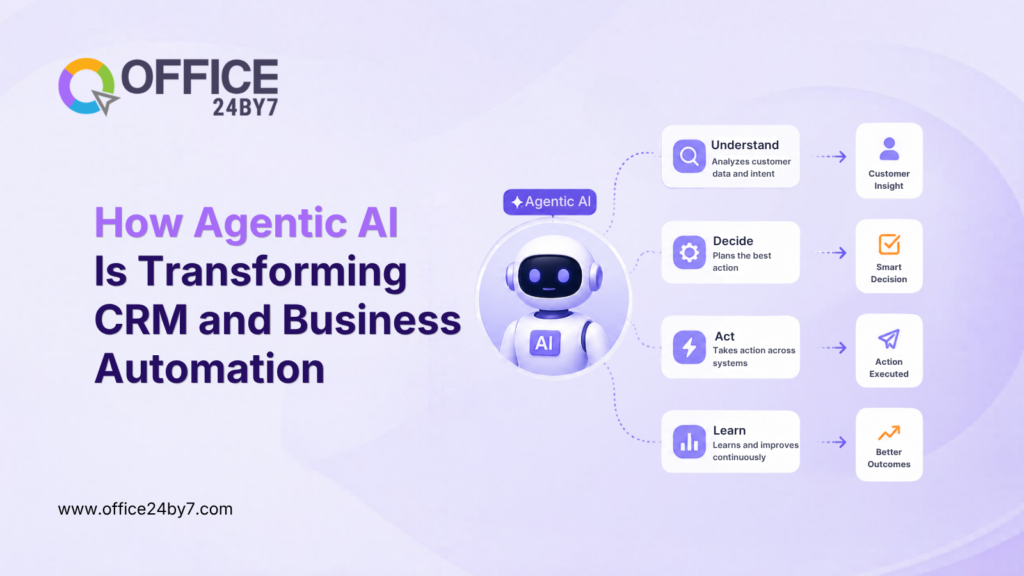
An agent doesn’t look at any one of those in isolation. It stitches them together. So when a prospect says, “we’re interested, but we need management approval next month,” the agent doesn’t just log it; it reads the intent, guesses at the timeline, and suggests the follow-up that fits. Then it updates the CRM, books the follow-up, and lets the salesperson know. On its own.
From Insight to Action: How AI Agents Complete Work
Once it’s read the conversation, the agent has choices to make: update the lead stage, write up an AI call summary, spin up a follow-up task, notify the agent, fire off a WhatsApp or email. All without anyone touching a keyboard.
Everything it does gets logged in the CRM and task management system, so a manager can always see what happened and what still needs a human.
Pricing, discounts, contracts: keep a person in that loop. Let the AI take the repetitive work off the table so people can focus on the decisions that actually need judgment.
Where Agentic AI Strengthens Sales, Support, and Marketing Automation
Once an agent can act instead of just suggest, the benefits show up across sales, support, and marketing at once.
On the sales side, lead tracker software lets an agent qualify incoming leads, read intent, and update the CRM without a rep ever touching it. Add click-to-call, and the moment a call ends, the agent is already dialing the next one.
On the support side, an agent wired into IVR services and a ticketing system can read a customer’s history, prioritize the issue, and route it with a summary attached. The customer stops having to explain themselves twice.
Smarter Customer Engagement Across Every Channel
Instead of running on a fixed schedule, an agent can fire off WhatsApp messages, SMS, and email based on what actually happened on a call. Miss a call, and the system logs it in the missed call service system and sends a WhatsApp follow-up right away. One trigger can handle both inbound and outbound marketing automation, with no separate workflows needed.
Why Connected Business Platforms Matter for AI Agents
Agentic AI only works as well as the systems feeding it. When CRM, communication channels, and workflow automation are connected, the agent has the context it needs to make better decisions. When they’re disconnected, it’s working with only half the picture.
Connected Systems Make Agentic AI More Effective
When conversations, CRM records, telephony, and workflow automation all draw from the same data, the agent has what it needs. Split those systems apart, and automation slows down and gets less reliable with it.
Office24by7 puts CRM, cloud telephony software, workflow automation, and customer communication on one platform, so an agent has the context to automate follow-ups and update records without anyone bouncing between tools.
Minimize your work efforts with automations!

What Indian Businesses Need Before Adopting Agentic AI in Sales CRM Software
Adopting an agent isn’t really a technology decision. It comes down to the data and habits already in place before the agent shows up.
Clean Customer Data Management and Human Approval
An agent is only as good as the data behind it. Duplicate contacts, half-filled records, stale information: all of that leads to bad decisions just as fast as it leads to bad reports. Clean it up first. Pricing, discounts, and contracts still need a person’s sign-off before anything’s final. Let AI take the repetitive operational work; keep people accountable for the calls that need judgment. Gartner expects more than 40% of agentic AI projects to get cancelled by 2027, and the reason isn’t the technology. It’s weak governance.
One Lead Generation Software Use Case at a Time
The mistake most teams make is trying to automate everything at once. Pick one problem to solve, whether that’s AI call summaries or lead nurturing inside your lead generation software, and prove it works before you touch anything else.
Conclusion
The businesses that get the most out of AI agents are the ones that clean up their CRM data, connect their communication channels, and define their workflows first.
None of this is about replacing sales or support teams. It’s about clearing out the admin work so people can spend their time on relationships, on solving problems, on closing deals.
Office24by7 puts CRM, cloud telephony, workflow automation, and customer communication on one platform, so businesses have what they need to bring in AI agents with confidence. Want to see how AI agents fit into your existing workflows? Call us at +91 70971 71717 or email sales@office24by7.com to get started.