
Try our 1-minute short audio summary of this blog on Sales CRM Implementation. 🎧
Every sales leader has heard the same promise. Buy a Sales CRM, get your team on board, and the sales will flow in. But for most companies, this is way different in reality. You buy the licenses, install them, and six months later, your sales team still updates their own spreadsheets, your sales pipeline remains a mess, and management wonders if it was a waste of time and money.
The integration of Office24by7 cloud telephony services with your CRM system, to automatically log all inbound and outbound calls against the appropriate customer record, is one of the first to deliver immediate value. But this is only effective if you have a sound strategy for implementation.
In this blog, we break down exactly why Sales CRM implementations fail, and what it takes to make them actually stick.
- Why Getting Sales CRM Right Transforms Your Entire Business
- Why Most Sales CRM Implementations Fail
- How Connection Gaps and Wrong Selection Sink Sales CRM Projects
- How to Build a Sales CRM Strategy That Actually Sticks
- What the Right Sales CRM Partner Makes Possible
- Why Office24by7 Is the Right Fit for Your Sales CRM
- Conclusion
Why Getting Sales CRM Right Transforms Your Entire Business
A Sales CRM is more than just a contact and opportunity manager. It transforms the way your entire organisation works, with sales, marketing, and support working from the same data set. According to Nucleus Research, businesses earn an average of $8.71 for every dollar spent on CRM. Companies that achieve this figure follow a clear strategy for their Sales CRM, secure strong leadership support, and stay connected across all channels their customers use. They connect sales, marketing, and support workflows into a single omnichannel marketing system that teams actually use.
How Sales CRM Strengthens Your Customer Lifecycle and Lead Nurturing
A properly set-up CRM provides full visibility to every department across the entire customer journey, from the first engagement with marketing through to renewal and advocacy. As marketing hands leads to sales and then to support, the system preserves the entire history of all interactions in a single integrated platform. No opportunity gets lost because someone misses a follow-up at the right time.
Your sales funnel is on a different level of efficiency when it’s directly linked to actual customer actions tracked in the CRM. Your sales team communicates based on what the customer did, a web page they visited, an e-book they downloaded, a webinar they attended, rather than the campaign calendar that is based on assumptions about where the customer might be in the buying cycle. Real customer behaviour drives lead nurturing workflow, making it scalable instead of based on assumptions.

Related Reading
How Successful Sales CRM Drives Conversion Rate and ROI Tracking
Organisations that successfully implement Sales CRM systems see an increase in conversion rate within a few months. Sales teams walk into every meeting with a complete picture of their relationship with the prospect, the history of the deal, open proposals, and the last conversation, all on one screen. They waste no time searching for information and instead focus on moving the relationships that ultimately bring in the revenue.
Moreover, ROI tracking becomes strategic and defensible at the executive level. Executive teams can see which campaigns provide the best quality leads, which team members close the most deals, and which stages of the pipeline are the most inefficient and frustrating. This changes the nature of budget allocation and performance management, and provides a single, data-driven direction for the organisation that leaders can build on quarter after quarter. CRM adoption also links directly to measurable performance improvements; companies report up to a 29% increase in revenue and improved forecasting accuracy when they use CRM effectively.
How Sales CRM Turns Customer Data Management Into a Revenue Engine
Bad data dooms most Sales CRM projects long before adoption issues appear. Poor data quality remains one of the biggest barriers to CRM success, with many organisations struggling to maintain accurate and complete customer records, directly impacting targeting, reporting, and customer experience. Poor data quality silently breaks targeting, sales conversations, and customer experience. Support asks questions that the customer has answered 20 times.
Good Sales CRM implementation addresses this at the source, by centralising the management of all customer information, validating records at the point of entry, automatically de-duplicating records, and ensuring that every record is up-to-date for every team that interacts with a customer. The result is analytics dashboards that management opens, believes, and uses, rather than reports they internally dismiss because they believe the data is wrong. Clean, connected, actionable data is the foundation that every sound business decision ultimately rests on.
Why Most Sales CRM Implementations Fail
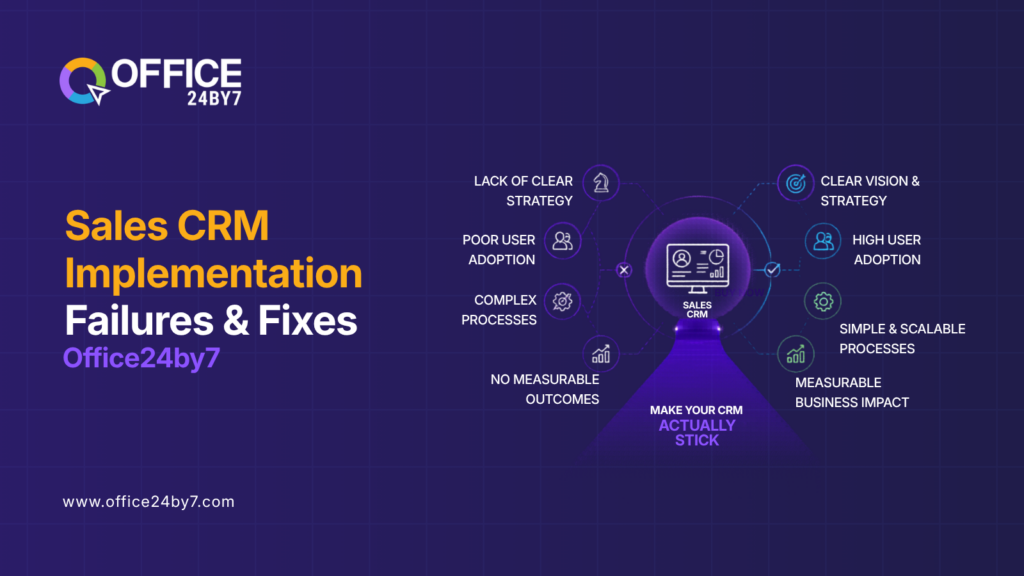
The causes of most CRM failures are the same, and none involve technology. CRM success is rarely a technology problem. Industry data shows that adoption and process alignment are the primary drivers of success, with failure rates closely tied to how well teams actually use the system. The software is almost always used as designed. It’s the strategy, the change management, and the inter-departmental coordination that surrounds the initial rollout that consistently fail.
If your sales automation software does not connect to your phone systems, marketing channels, and support processes, your CRM captures only a small part of your customers’ journey. Every sales forecast and every marketing campaign your team creates based on this data fails to perform as well as it could – and no one knows why. By linking click-to-call software to your Sales CRM system, you automatically log every outbound call without manual entry. It helps remove one of the most common causes of data loss in enterprise sales.
Low adoption
Sales teams don’t see value, so they default to spreadsheets and minimal updates. Research compiled from industry reports shows that nearly 30% of CRM implementations fail, most often due to low user adoption and poor change management. Salespeople who were not part of the selection process often view the CRM as a “necessary evil”. They keep their own spreadsheets, input the bare minimum data under pressure, and create workarounds that render the CRM data set useless as an asset for business strategy.
Disconnected systems
When CRM does not connect to calls, messaging, and marketing channels, teams lose critical data. A missed-call service connected to your Sales CRM automatically logs all inbound call attempts and prompts the appropriate follow-up action without any intervention from your sales team. No opportunity slips through the cracks because your team missed a call during a busy day or at the wrong time.
Poor tool fit
CRMs selected based on features rather than workflows fail after go-live. An integrated CRM automatically captures all messaging conversations and creates a 360-degree view of your customer across voice, chat, and email channels. If these unified systems are not in place from the beginning, you will never have a complete picture of your customers, and every attempt your team makes to personalise their experience will fall short because the data is missing.
How Connection Gaps and Wrong Selection Sink Sales CRM Projects
The wrong fit is one of the most frequent reasons for lack of adoption and failed CRM installations. Organisations typically choose their Sales CRM based on a feature comparison spreadsheet rather than how well it fits their existing workflows. Teams often discover the problem only after go-live, when changing course becomes too costly and disruptive.
An integrated task management system built into your CRM system keeps everyone on the team accountable, with tasks, deadlines, and statuses all in one place, without the need to switch between multiple project management tools.
A dedicated SaaS solution for enterprise sales teams integrates your CRM with all customer interaction channels. By saving time, it encourages adoption, transforming the CRM into a helpful tool rather than something to avoid.
How to Build a Sales CRM Strategy That Actually Sticks
Teams typically treat Sales CRM as a technology project with a fixed duration. However, the most successful teams view it as an ongoing business change, prioritizing adoption, data integrity, and process improvement. This perspective significantly impacts roll-out strategies, internal communications, and success metrics over time.
Instead of a big rollout, adopt a phased implementation approach. Integrating a ticketing management system from the start allows automatic logging of support tickets against the correct CRM records, giving managers insights into resolution times and escalation rates without extra tracking.
Additionally, integrating inbound marketing channels early ensures that the system automatically tracks all lead sources, search, paid ads, content downloads, and event registrations in the Sales CRM. This leads to budget decisions based on real pipeline data rather than misleading last-click attribution models.
Seamless Sales CRM Deployment for Enterprise Teams
A comprehensive Sales CRM rollout plan for enterprise teams also requires documented processes for all your customer communication channels. Here’s what it looks like in a seamless deployment:
- Automated workflow rules that move leads through the pipeline based on actual customer behaviour, a proposal viewed, a demo attended, a form filled out, rather than manual updates that agents neglect when under pressure.
- SMS marketing campaigns integrate with the Sales CRM, so the system automatically updates every click, opt-out, and response in the customer record without manual effort.
- Drip marketing automation campaigns that run on real, actionable triggers, such as a pricing page viewed, a resource downloaded, or a follow-up missed, to keep prospects engaged between sales meetings without adding to the burden of an overburdened sales team.
With these basics in place, teams must integrate outbound marketing campaigns with the Sales CRM so the system automatically updates every click, response, and opt-out in the correct customer record and triggers the next step. Lastly, an omnichannel marketing platform layer integrates all channels, email, WhatsApp, SMS, and voice, into a single view that all team members access and respond to in a single interface, with no need to switch between different tools during the day.
What the Right Sales CRM Partner Makes Possible
Your partner for a Sales CRM implementation does not just install the system and leave you to get on with it. They understand your processes before they configure anything. Ensures each department uses the same data definitions. They integrate all the communication channels your customers are using. And they ensure data is clean from the start, so your team can focus on the right prospects, not the first three months of data cleanup.
Cross-selling and upselling features built into your Sales CRM present the right product to the right customer at the right time, based on actual purchase data, engagement metrics, and behavioral patterns, rather than leaving upselling and cross-selling to manual prospecting that your sales team doesn’t have time for.
A fully integrated Sales CRM implementation with Office24by7 links all channels your company uses:
- IVR services that intelligently route all incoming calls to the right agent, automatically log the call against the customer’s CRM profile, and provide 24-hour self-service for common customer queries.
- Voice broadcasting service that delivers bulk notifications to large customer segments, notifying them of renewals, campaign changes, and new product releases, all linked to individual Sales CRM records with full attribution and response tracking.
- A virtual number service ensures that each campaign, department, and location is tracked separately with distinct trackable numbers, while the system logs all activity under the same CRM account for clear, unambiguous enterprise-wide reporting.
Related Reading
Why Office24by7 Is the Right Fit for Your Sales CRM
Office24by7 provides your mobile workforce and on-site teams with an omnipresent mobile CRM, full customer profiles, real-time task allocation, and complete communication history on any device, at any location, at any time of day. No data is lost because the salesperson was out of the office when the customer called.
The Office24by7 subscription model means your organisation has access to enterprise-level CRM, telephony, and automation without significant up-front investment. You grow the solution in line with your real business growth, adding channels, users, and automation as your team grows, rather than investing in capacity you will not reach for another 18 months. For CFOs considering the total cost of ownership and IT leaders considering the risks of implementation, this makes a huge difference to the investment calculus.
With built-in marketing automation software, your sales and marketing teams work within a connected system instead of relying on two loosely integrated systems that break whenever either one is upgraded. This integrated stack is what makes adoption stick, rather than a month-one explosion and then back to the spreadsheet.
Conclusion
Failure of Sales CRM is not a given. It is not only inevitable, but also avoidable, if you take the right approach, align the right team, and invest in adoption across the entire organisation.
CRM success comes down to clarity of goals, strong adoption, and connected systems, not just software deployment.
The companies that get their CRM right have clear objectives, engage their people early, integrate all channels of communication into a single view of data, and select a partner who focuses on long-term adoption, rather than a quick go-live. The true value of your CRM is what you do with it day in and day out.
Want to get your Sales CRM right the first time? Talk to the Office24by7 team today, call us at: +91-7097171717 or email: sales@office24by7.com