Try our 1-minute short audio summary of this blog on WhatsApp Business 🎧
For many companies, the initial contact with their customer may not be through a website.
It occurs on WhatsApp.
A customer asks for the cost of a product. A person would like to know if a property is available. A patient is requesting an appointment. A quotation is required for a business buyer. In every instance, the customer needs an immediate response to determine their next steps.
This brief exchange now can be an integral part of the sales process.
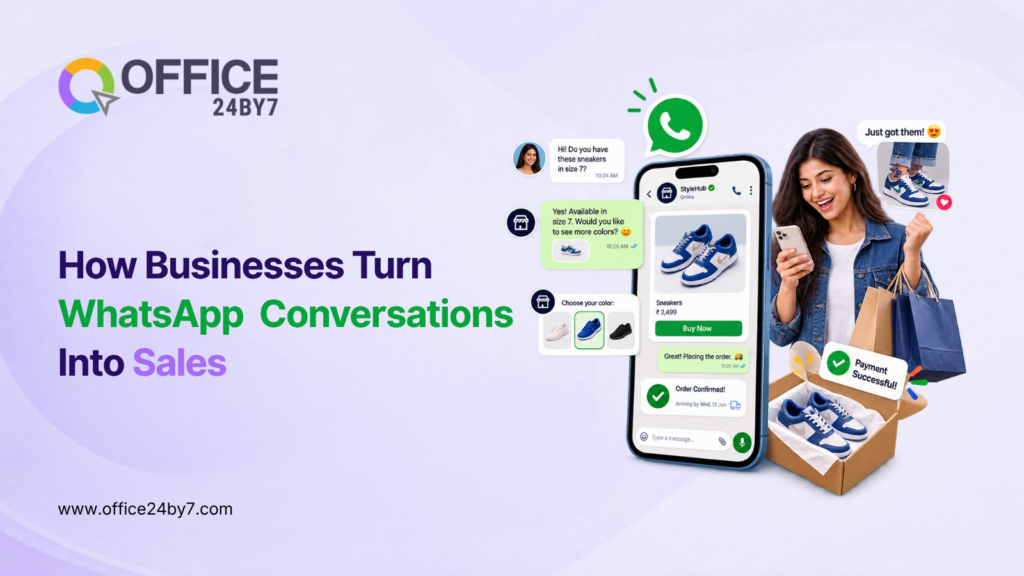
WhatsApp Business has grown from just a customer messaging tool. Businesses can leverage these conversations to create structured and trackable customer experiences using the right mix of WhatsApp API, WhatsApp automation, WhatsApp chatbot, and CRM software. Businesses can have the ability to collect enquiries and know the requirements of customers. They can follow up on time and maintain continuity in the conversation.
The opportunity is particularly relevant in India. A 2026 Meta and Retailers Association of India study found that 72% of product discovery happens on WhatsApp. The same study found that retailers using Business Messaging and Click-to-WhatsApp campaigns saw a 61% average improvement in return on ad spend, 62% more leads generated, and 22% higher order values.
But simply having a WhatsApp number isn’t a sales strategy. The real opportunity lies in what happens after the customer sends that first message.
- Why WhatsApp Is Becoming Part of the Buying Journey
- WhatsApp Business vs WhatsApp API: When Does a Business Need More?
- Where WhatsApp Automation Actually Helps
- Why WhatsApp and CRM Work Better Together
- WhatsApp Can Support More Than the Sale
- What Makes WhatsApp Commerce Different?
- Don’t Make WhatsApp Another Isolated Tool
- Measure Sales, Not Just Messages
- Where Office24by7 Fits In
- The Future of WhatsApp Business Is More Conversational
- Conclusion
Why WhatsApp Is Becoming Part of the Buying Journey
People are already using WhatsApp to communicate with friends, family, and businesses. That familiarity takes one of the biggest hurdles out of the way for digital engagement: the need to learn another platform.
According to a 2025 Kantar study cited by Meta, 91% of online adults in India are using chat with a business at least once a week.
That presents a natural opportunity for businesses. A customer might be shown an ad and then click through to WhatsApp. They don’t fill in a form; they ask a question. One might find a product online but want to talk to someone before purchase. A prospect that does not buy today may come back to the same conversation at a later time.
Not all journeys go in a straight line. You could start a conversation on Instagram, visit your website, and follow up on WhatsApp. They may eventually talk to a salesperson on the phone. That’s where an omnichannel marketing platform and CRM come in handy. To the customer, it is one relationship. Your systems should do the same!

Related Reading
WhatsApp Business vs WhatsApp API: When Does a Business Need More?
For a large number of small businesses, the WhatsApp Business app is a good option. A few conversations can be handled by a small team. If so, it might not be necessary to set up a complicated system.
The issue typically comes up as the business expands. Then, all of a sudden, several salespeople are answering customers. Leads are being generated from various campaigns. Some enquiries are being missed. There has to be someone who remembers to follow up. Managers need to know how many enquiries were converted, but this data is available in individual chats.
That’s where the WhatsApp API comes in handy.
What the WhatsApp API changes
The API enables WhatsApp to integrate with other applications, such as CRM platforms, marketing automation platforms, and support platforms. Businesses can use messages as a component of a larger workflow rather than as individual conversations.
A new WhatsApp inquiry can be converted to a lead, assigned to the proper salesperson, and then followed up with an automatic task or notification.
Not all APIs are mandatory from the get-go. When WhatsApp is no longer a “one-person inbox,” it becomes more valuable.
Where WhatsApp Automation Actually Helps
Businesses can get the idea of complex bots and lengthy menus when they hear the term automation. But it doesn’t have to be this way.
Good WhatsApp automation is just taking away repetitive tasks. A customer who calls to enquire about your business hours shouldn’t be waiting for an employee to respond. A person who checks on the status of an order shouldn’t have to ask a salesperson to check it manually. A new enquiry should not be left unanswered due to someone’s lack of time.
A WhatsApp chatbot can manage common interactions, gather fundamental data, and assist customers to the appropriate subsequent step.
The human handoff still matters
Automation is best when it’s aware of its limits. A chatbot can respond to common questions, gather the requirements, or assist in selecting a category. However, if the sale is a big one, the negotiation is high-value, or a complaint is high-value, a person may be required.
The aim is to ensure that staff are engaged in conversations that have value. Automation isn’t supposed to take humans out of the equation.
Meta’s recent Business AI advancements are in the same direction. Its Business AI feature for qualified small businesses in India can respond to customer queries, suggest products, collect leads, schedule appointments, and guide customers to make a sale. Businesses can also intervene at any time when there is a need for human intervention.
This is a more effective approach to thinking about automation. Have technology take care of the mundane tasks and allow for focus on the conversations that matter.
Why WhatsApp and CRM Work Better Together
You can have information that is important to a sale in a WhatsApp conversation. The customer’s requirements may include a budget, location, product preference, urgency, or reason for their search.
When this information remains in a chat, it is hard to use in the future. With WhatsApp integration with CRM software, the conversation can be stored in the customer’s record.
From message to lead
A basic process might be as follows:
Enquiry via WhatsApp → Lead captured → Lead qualified → Salesperson assigned to follow up → Conversion
The customer need not be aware of any of this going on behind the scenes. However, it means a big difference to the sales team.
Lead tracker software can provide the information on who owns an enquiry and what stage it is at. It also indicates what is in need of attention. The task management software can remind the salesperson to follow up. Workflow automation can automate repetitive tasks, rather than having to manually update each record.
This is where WhatsApp CRM automation can be helpful. It ties the conversation into the sales process and doesn’t leave WhatsApp as a stand-alone.
It also enhances customer data management. Customer information is frequently distributed across WhatsApp, spreadsheets, emails, and personal notes. Rather, teams can use a single, uniform record.
WhatsApp Can Support More Than the Sale
There’s one thing that makes WhatsApp so valuable, and that is the fact that the relationship does not come to an end once a customer purchases something. Remind people of appointments, update orders, remind people to pay, notify them of services, and provide support on the same channel.
That’s the way a customer would think. They don’t have to dial a different support phone number or keep track of an email address to send to.
WhatsApp can also be used for businesses with longer sales cycles to nurture leads. The prospect who asks about a service will not be ready to purchase until next month. A follow-up can be relevant and maintain the conversation without the salesperson having to remember all the enquiries manually.
Businesses can also integrate WhatsApp with email marketing automation, SMS marketing automation, or drip campaigns depending on the customer journey.
Relevance is the important word. But more messages don’t necessarily equal better marketing.
What Makes WhatsApp Commerce Different?
This is where WhatsApp Commerce really transforms into another term for WhatsApp marketing.
When buying from traditional online retailers, the process can often leave customers on their own to research, compare, and make a choice. It works great for some purchases. Reassurance must be given to others. Understanding what is involved is important. Interest lies in whether a service is suitable. A comparison between two choices is needed. There may be a desire to talk to someone
That friction can be eliminated when talking. This is especially useful for higher-consideration products and services. Consider real estate, education, healthcare, financial services, travel, and B2B solutions.
This is evident in Meta’s research on the Indian market in 2026, which characterizes WhatsApp as being “engaged with discovery, purchase, and post-purchase engagement”.
WhatsApp Commerce isn’t an alternative to the website. It enriches the buying experience with an interactive element, allowing customers to inquire, seek advice, and proceed without having to begin their process elsewhere.
Don’t Make WhatsApp Another Isolated Tool
There is a bigger issue hiding underneath all of this.
A business may have WhatsApp for messages, a CRM for leads, and a calling system for sales. It may also use email software for campaigns and a ticketing platform for support. Individually, each tool may work well. Together, they can create a mess.
A customer may speak to a salesperson on WhatsApp, call the next day, and then email support. If none of those interactions are connected, the customer may have to explain everything again. A connected CRM can reduce that problem.
For example, click-to-call software can help a salesperson move a high-intent WhatsApp conversation to a call. Cloud telephony services can connect calls with customer records. An IVR system can then route incoming calls to the right team.
If a customer cannot get through, a missed call alert system can help the team follow up. For broader campaigns, businesses may use various communication channels. Support teams can move complex issues into a ticketing management system. That beats trying to manage every problem inside a chat.
The point is to make the existing channels work together, not add more of them.
Measure Sales, Not Just Messages
One of the easiest mistakes to make with WhatsApp is measuring activity instead of results. A campaign that sends thousands of messages can look successful on paper.
But how many people responded? How many became qualified leads? How many actually bought? And how much revenue did the campaign generate? Those are the numbers that matter.
Analytics dashboards let businesses track response rates, lead quality, and conversion rates. They also cover appointments, order values, repeat purchases, and revenue.
This also makes ROI tracking more meaningful. For example, a campaign generating 300 highly relevant conversations may be far more valuable than one generating 3,000 low-quality responses.
The same principle applies to the sales funnel. WhatsApp should help businesses understand where customers are moving forward and where they are dropping out.
This is where CRM data becomes valuable beyond day-to-day operations. It gives sales and marketing teams a clearer picture of what actually contributes to revenue.
For more on CRM performance measurement, read Office24by7’s CRM Metrics: How to Measure CRM ROI Effectively.
Related Reading
Where Office24by7 Fits In
For businesses already using WhatsApp heavily, the bigger opportunity is not adding another standalone tool. It is connecting WhatsApp with the rest of the business.
When WhatsApp is connected to CRM, the sales team can see the lead, conversation history, and next action in one place. That makes it easier to move from an enquiry to qualification, follow-up, and conversion without switching between multiple systems.
Office24by7’s WhatsApp Business API can integrate with its CRM. This gives teams one view of customer interactions and supports lead qualification, follow-ups, sales conversations, and analytics. Its WhatsApp chatbot capabilities can also support personalised conversation flows and lead capture. They can share product or service information, payment reminders, and customer updates.
Office24by7 brings communication, sales, marketing, and service capabilities into one platform. WhatsApp conversations can then sit alongside calls, email, SMS, and support interactions rather than living separately.
That gives businesses a more connected way to manage the customer journey. A WhatsApp enquiry can become a lead. A lead can become an opportunity. An opportunity can become a sale. And the conversation can continue after the sale.
The Future of WhatsApp Business Is More Conversational
WhatsApp is moving towards a model where customers can do more without leaving the conversation.
In India, Meta has already introduced Business AI. It can answer questions, recommend products, capture leads, and book appointments. Meta’s May 2026 announcement says Business AI will soon facilitate payments within a WhatsApp chat using UPI.
These developments point to a broader change in how businesses will think about messaging. WhatsApp won’t simply be the place where a customer asks, “What’s the price?” It can become part of the journey from discovery to conversation, recommendation, purchase, and post-purchase support.
For businesses, the challenge will be keeping that experience useful rather than overwhelming. The companies that get it right won’t necessarily be the ones sending the most messages. They’ll be the ones making each conversation more relevant.
Conclusion
WhatsApp Business has become much more than a convenient way for customers to contact a company. Used properly, it can become part of the entire customer journey.
The WhatsApp API provides the connection to business systems. WhatsApp automation takes care of repetitive work. A WhatsApp chatbot can handle routine conversations. CRM software keeps customer information and sales activity connected.
Together, these tools make it easier to respond quickly, manage leads, follow up consistently, and understand which conversations actually contribute to revenue.
But technology is only part of the answer. The best WhatsApp strategy is still a simple one:
Give customers a reason to start the conversation, make it easy to continue, and make sure your team knows what to do next. Call us at +91-7097171717 or email us at sales@office24by7.com.
Visit www.office24by7.com for more information.