Try our 1-minute short audio summary of this blog on Omnichannel CRM. 🎧
A customer calls your support line, is placed on hold, and then hangs up to send a WhatsApp message. The agent responding to the interaction is unable to view the previous interaction, which can cause a frustrating experience and loss of customer trust. This is not a support problem; it’s a systems failure and happens often when companies work on a channel-by-channel basis.
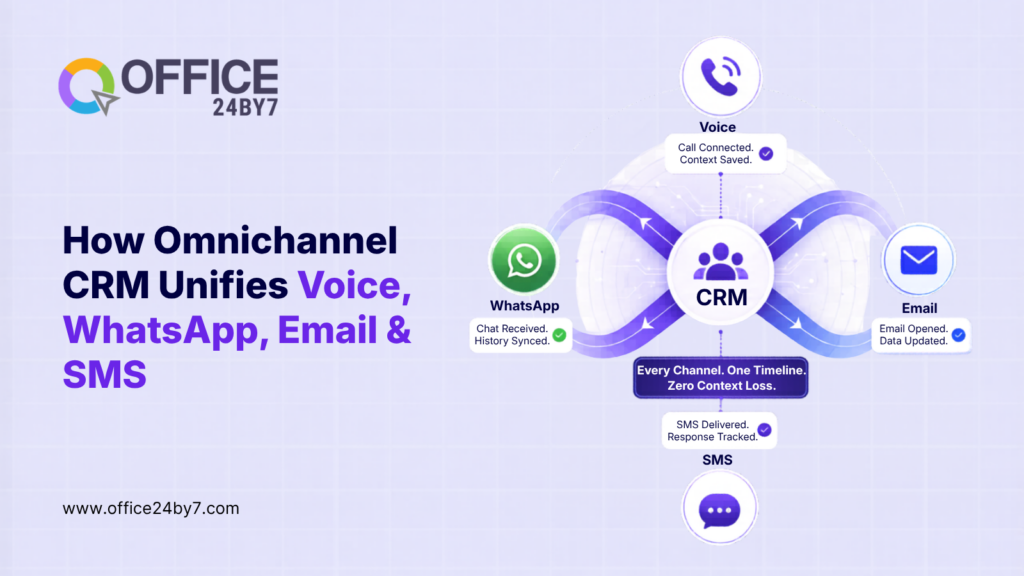
By 2026, customers will want to be able to switch between voice, WhatsApp, email, and SMS. An omnichannel CRM integrates these channels into a single platform, so your team can seamlessly continue conversations, no matter the channel.
- What Is Omnichannel Customer Experience and Why It Matters in 2026
- Why Traditional CRM Systems Fail at Customer Experience
- The Hidden Cost of Manual Communication Management
- How Omnichannel CRM Creates a Single Customer View
- Building Omnichannel CRM Infrastructure That Scales
- Must-Have Features and Implementation Best Practices for Omnichannel CRM
- Measuring ROI, Office24by7 Advantages, and Future Trends for Omnichannel CRM in 2026–2027
- How Office24by7 Delivers Omnichannel CRM Success
- Conclusion
What Is Omnichannel Customer Experience and Why It Matters in 2026
Omnichannel customer experience lets customers switch channels without repeating themselves or losing conversation context. The business holds the conversation context, not the customer.
This is fundamentally different from multichannel communication. Multichannel means a business is present across multiple channels. Omnichannel CRM shares customer data, context, and history across channels in real time.
Omnichannel vs Multichannel: Key Differences in Omnichannel CRM
Most businesses today operate across multiple channels. Having multiple channels does not mean having them joined together. With cloud telephony services, email, and messaging services operating separately, each channel becomes a separate version of the same customer. Data fragments. At each handoff point, there is no context.
Omnichannel CRM connects all interactions to one updated customer profile across every communication channel.
Rising Customer Expectations and Omnichannel CRM
90% of customers expect consistent interactions across every channel they use, and businesses that don’t provide them are losing trust and repeat business in no time.
WhatsApp automation has become one of the most impactful entry points for businesses adopting omnichannel CRM. With more than 500 million WhatsApp users, integrating WhatsApp into a unified CRM is no longer a differentiator.
Why Omnichannel CRM Drives Higher Engagement and Revenue
Companies with strong omnichannel customer engagement retain 89% of their customers, while companies with weak omnichannel strategies keep only 33% of their customers (Aberdeen Research). The 56-point difference is the full benefit of connected communication infrastructure investments.
Email marketing automation improves engagement using real customer actions instead of fixed campaign schedules. This leads to increased conversion rates, repeat sales, and significantly improved customer relationships at every touchpoint.
Why Traditional CRM Systems Fail at Customer Experience
Traditional CRM systems relied on desktop interfaces built mainly for single-channel sales communication. Developers never designed them for the multi-channel, always-on customer interactions that define buying behaviour in 2026.
Businesses face major customer experience issues when disconnected channels operate inside separate CRM systems. SMS marketing automation that doesn’t integrate with the voice record. Emails that do not show the previous WhatsApp conversation. All of these gaps come at the expense of the customer’s time, patience, and ultimately loyalty.
Fragmented Customer Data and Context Loss
The most immediate and damaging consequence of disconnected systems is context loss. A customer interaction should seamlessly flow from channel to channel and retain the history of previous conversations. When continuity breaks, customers feel that your business neither listens nor remembers previous interactions.
Unified customer data management inside an omnichannel CRM eliminates this issue. All interactions, no matter the channel, are written to the same customer profile. The next agent to contact that customer has all the information. The outcome is that discussions begin where they ended, instead of from a blank screen.
The Productivity Cost of Tool Switching in Omnichannel CRM
Studies have repeatedly revealed that each time an agent has to switch tools during a customer interaction, he or she loses 10 to 20 minutes of productive time each day. This can result in hundreds of hours of wasted time each month for expanding support teams as they waste time navigating systems rather than solving customer problems.
This is where workflow automation in an integrated CRM platform reduces much of this operational overhead. Agents access all channels from a single interface. The system transfers context automatically across channels. Automated task assignments and follow-up triggers keep teams focused on meaningful customer conversations.
The Hidden Cost of Manual Communication Management
Every manual step in a communication workflow is a potential failure point. Teams leave notes behind. They forget to set reminders. Escalations remain unnoticed in personal inboxes without visibility from other team members.
Manual communication management isn’t only an operational inefficiency; it’s the kind of inconsistency that customers feel and know. Lead generation software brings in leads, but manual processes often lose them before conversion.
Communication Channels Every CRM Must Unify
The primary customer communication channels today include voice, WhatsApp, email, and SMS. They are used for different types of interactions and at different stages of the customer journey. An effective omnichannel CRM doesn’t view them as separate channels, but rather as part of a single, connected conversation.
Voice and Cloud Telephony for Real-Time CRM Conversations
Voice remains the highest-trust channel for complex queries, escalations, and high-value customer conversations. IVR services integrated into a CRM platform intelligently route inbound calls based on query type, agent availability, and customer value. Additionally, the system automatically logs every interaction to the correct CRM profile without requiring manual effort from agents.
Click-to-call software lets agents connect with customers with a single tap from the CRM dashboard. Meanwhile, the system automatically saves call recordings and outcomes to the customer record. Conversations continue seamlessly across channels, allowing support teams to maintain continuity without losing context.
WhatsApp Business API for Instant Omnichannel CRM Engagement
With 98% open rates, WhatsApp remains the most engaging channel for real-time customer communication, compared to approximately 20% for email. Additionally, a WhatsApp Bot embedded within your unified customer communication platform can automatically handle repetitive inquiries, qualify inbound leads, and escalate complex issues with a complete conversation history available.
Drip marketing automation also integrates seamlessly with WhatsApp, extending engagement across the entire customer lifecycle, from onboarding to re-engagement campaigns based on customer behaviour rather than timing. Furthermore, the system automatically records all conversations and links them to voice, email, and SMS interactions within a single customer timeline.
How Omnichannel CRM Creates a Single Customer View
Every business claims to be customer-centric. Few provide teams with the means to truly function in that manner. Tightly coupled communication systems and a centralised customer database are the bases of a single customer view. Omnichannel CRM is a system that integrates all channels, all touchpoints, and all interactions into a single, up-to-date customer profile that all team members can view from a single location.
Customer 360° View and Unified Interaction History in CRM
A unified interaction timeline inside your integrated CRM platform shows all calls, WhatsApp chats, emails, SMS, and support tickets from the same customer in one timeline. Before responding to a customer, agents can view purchase history, previous interactions with the customer’s support team, outstanding issues, and engagement activity across all channels, all in one place.
This full perspective benefits every phase of the customer journey, from initial engagement to renewal and advocacy. Analytics dashboards built on unified data surface patterns that fragmented systems cannot see: Customers in danger of churn, customers ready for an expansion conversation, customers that need proactive outreach before a friction point becomes a formal complaint.
Building Omnichannel CRM Infrastructure That Scales
The most common reason omnichannel CRM implementations fail is that businesses focus on the front-end experience without addressing the technical foundation underneath it. The key to centralized communication infrastructure success lies in real-time synchronization, API-based integrations, and centralized routing that ensures accurate customer data across all channels.
Mobile CRM access is an essential part of a scalable omnichannel infrastructure. Whether they are in the field, working remotely, or on-site, the complete customer view must be available across desktop and mobile, and must not compromise on functionality or customer context.
Essential Technical Requirements for Omnichannel CRM Infrastructure
To achieve a scalable omnichannel CRM infrastructure, it is essential to have an API-first integration approach that integrates all communication channels with a single data layer. As a result, the platform updates customer activities in real time without delays between customer actions and team visibility. Event-driven workflows trigger the appropriate actions whenever customer behavior signals appear across any channel.
Moreover, security and compliance are just as important as performance. All channels gathering customer information, voice messages, WhatsApp chats, email threads, and SMS replies should be able to store and process all data in full compliance with the Digital Personal Data Protection Act (DPDPA) of India. In 2026, businesses must build compliance into the integrated communication ecosystem from the beginning instead of treating it as a post-deployment concern.
Integrating Cloud Telephony, IVR, WhatsApp API, Email, and SMS into Omnichannel CRM
Sales automation software integrated with your omnichannel CRM ensures that every lead entering your pipeline receives the same automated follow-up process, whether it comes from a web form, a WhatsApp message, or a direct phone call.
In practice, a comprehensive centralized communication infrastructure integration stack offers the following benefits:
- Virtual number service for multiple campaigns, departments, and geographies under separate, fully trackable numbers, with all activity funnelled into one unified CRM account for clean, unambiguous attribution
- Cloud telephony integration automatically logs all inbound and outbound calls to the appropriate customer record and maintains the full call history and outcomes.
- WhatsApp Business API integration showing all chat history, voice, email, and SMS interactions in a single, real-time customer timeline
- The platform integrates automated email and SMS campaigns using customer behavior data instead of relying on predetermined schedules.
Must-Have Features and Implementation Best Practices for Omnichannel CRM
The key to using the right omnichannel CRM features and making them effective is to ensure that the platform’s capabilities align with the workflows of your business, rather than to simply install all of the features and hope for adoption.
Real-Time Routing, Automation, and Analytics in Omnichannel CRM
Intelligent routing sends all incoming interactions, calls, chats, emails, or SMS to the appropriate agent the moment they arrive, according to rules that your team sets up and continually improves over time. Furthermore, lead-nurturing workflows send personalised sequences based on your prospects’ actual behaviour. This routing feature ensures every prospect gets the right experience at the right time, without manual coordination between team members.
In addition, unified analytics dashboards surface the metrics that directly impact operational and revenue decisions. Response times per channel, first contact resolution rates by interaction type, channel conversion performance, and individual agent productivity by each channel. A well-developed omnichannel CRM should provide the following without any manual work:
- Multi-channel real-time agent routing and queue management at once
- Chatbot automation handles routine queries across WhatsApp, SMS, and web channels without requiring agent intervention.
- Outbound sequences and inbound response tracking in one view, all managed by campaign management.
- Customer segmentation based on full, not single-channel, behavioral data.
- Internal collaboration features allow agents to refer to other agents in the same conversation without putting the customer on hold.
Mapping Customer Journeys and Testing Workflows in Omnichannel CRM
Before implementing any omnichannel CRM workflow, sketch the entire customer journey through all the channels your business utilises. Map every handoff that occurs when customers switch between WhatsApp, voice calls, emails, and support tickets, and identify which customer information, conversation history, and workflow data your systems should automatically share.
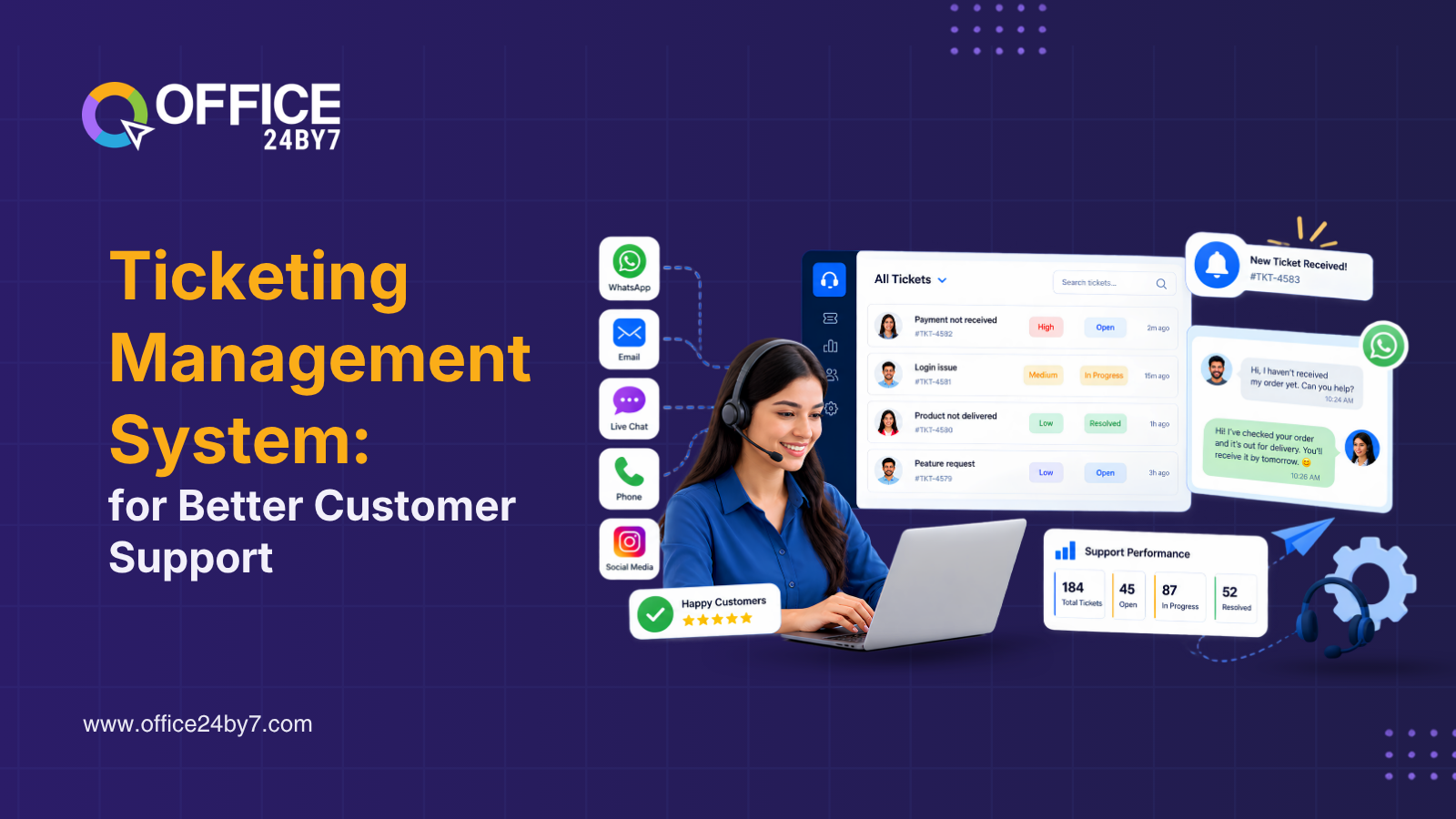
Integration with the ticketing management system guarantees that every escalation is accompanied by all the context from the initial channel. When the support agent receives a ticket from a WhatsApp conversation, he or she will see all the previous conversations, all the previous calls, and all the details of the accounts that are relevant to the conversation before sending a single word of response. Task management system workflows then automatically assign follow-up tasks to the appropriate team member, ensuring that important next steps don’t end up in an unassigned queue due to unclear ownership.
Team Training, Rollout Strategy, and Optimization for Omnichannel CRM
A phased launch beats a full-scale launch when it comes to implementing omnichannel CRM. Begin with a single team, one main channel, and one set of measurable objectives. Evaluate the value first, then expand. Then gradually scale up each step, based on proven outcomes of previous steps.
The missed call alert system delivers one of the fastest wins during the initial rollout phase because businesses frequently lose leads through missed calls. Teams can solve this issue without making major behavioural changes. Voice broadcasting services also help businesses proactively communicate campaign messages, service updates, and critical announcements to large customer bases while tracking every interaction back to individual CRM records with complete response attribution. Before adding advanced automation layers, train your team on the unified customer dashboard and give them a complete customer view before the system automatically routes interactions.
Measuring ROI, Office24by7 Advantages, and Future Trends for Omnichannel CRM in 2026–2027
The metrics used to measure the success of omnichannel CRM should focus on the overall customer journey, not just on individual channels. Track all these metrics to measure ROI: First Contact Resolution Rate by channel, Average Response Time by channel, Customer Satisfaction Score by interaction type, Agent Productivity by touchpoint, and Revenue generated through automated follow-up sequences. Additionally, inbound marketing automation conversion rates and outbound marketing automation response rates provide a good indication of your integrated platform’s performance in turning communication efforts into tangible business results.
How Office24by7 Delivers Omnichannel CRM Success
Office24by7 integrates voice, WhatsApp, SMS, email, IVR, and CRM automation into a single unified platform, designed specifically for handling high-volume, multi-channel customer interactions. Office24by7 designed the platform to scale customer engagement by bringing communication channels, customer data, automation, and reporting into a single operational environment. It handles intelligent routing, automated workflows, real-time analytics, complete mobile access, and up-selling and cross-selling tools that identify the right revenue opportunity at the right time, using complete behavioral data from all channels your customers use.
Predictive personalisation is quickly becoming a baseline expectation. By 2027, AI-driven omnichannel CRM will be able to predict customer needs before they even know they need them, prompting proactive communication based on their activity, purchase history, and engagement patterns. As businesses automate more customer queries, Conversational CRM will make interactions feel increasingly human. The AI-powered engagement scoring will give your team a clear understanding of who to target, when to target them, and how to reach them, turning your communication strategy into a true data-driven approach and not one based on experience and intuition.
Next Steps for Businesses
Assess your existing CRM and communication systems to see how they align with the omnichannel needs outlined in this guide. Identify the highest-friction handoff points in your customer journey where customers lose context or repeat themselves, and prioritize fixing those moments during the first phase of integration. Get a live demonstration from Office24by7 and experience the unification of voice, WhatsApp, email, and SMS management at your scale and level of operational complexity.
Conclusion
Omnichannel CRM is not a feature upgrade. It’s an operational change, from channel management to relationship management, across all channels.
The businesses winning customer loyalty in 2026 are the ones whose systems remember everything, so their teams never ask customers to repeat themselves. One call, one message, one email, one timeline, one platform, one seamless experience from the initial contact to long-term retention.
Office24by7 provides your team just that. A single platform for voice, WhatsApp, SMS, and email, unified, automated, and scalable for your business.
Looking for a unified customer experience across all channels? Call us at: +91-7097171717 or send an email to: sales@office24by7.com.